10 Sep Engagement Rings: Choosing the Right Precious Metal Color
When designing a custom engagement ring, many San Diego couples spend their early conversations on the center stone — shape, carat weight, color, clarity. The metal often gets treated as an afterthought, a finishing touch of white, yellow, or rose picked once the “real” decisions are already made.
But the metal isn’t a finishing touch. It’s part of the ring’s architecture. It shapes how the diamond reads, how the ring sits on the hand, how the piece holds up over decades, how much upkeep it will need, and how well it will eventually pair with a wedding band.
The same ring design can look crisp and modern, warm and traditional, or quietly romantic depending on what it’s made of.
That’s part of why choosing a metal from a swatch or a photo of someone else’s ring rarely works well. The better question isn’t “which metal do I like?” It’s “which metal draws out what I actually want from this design?”
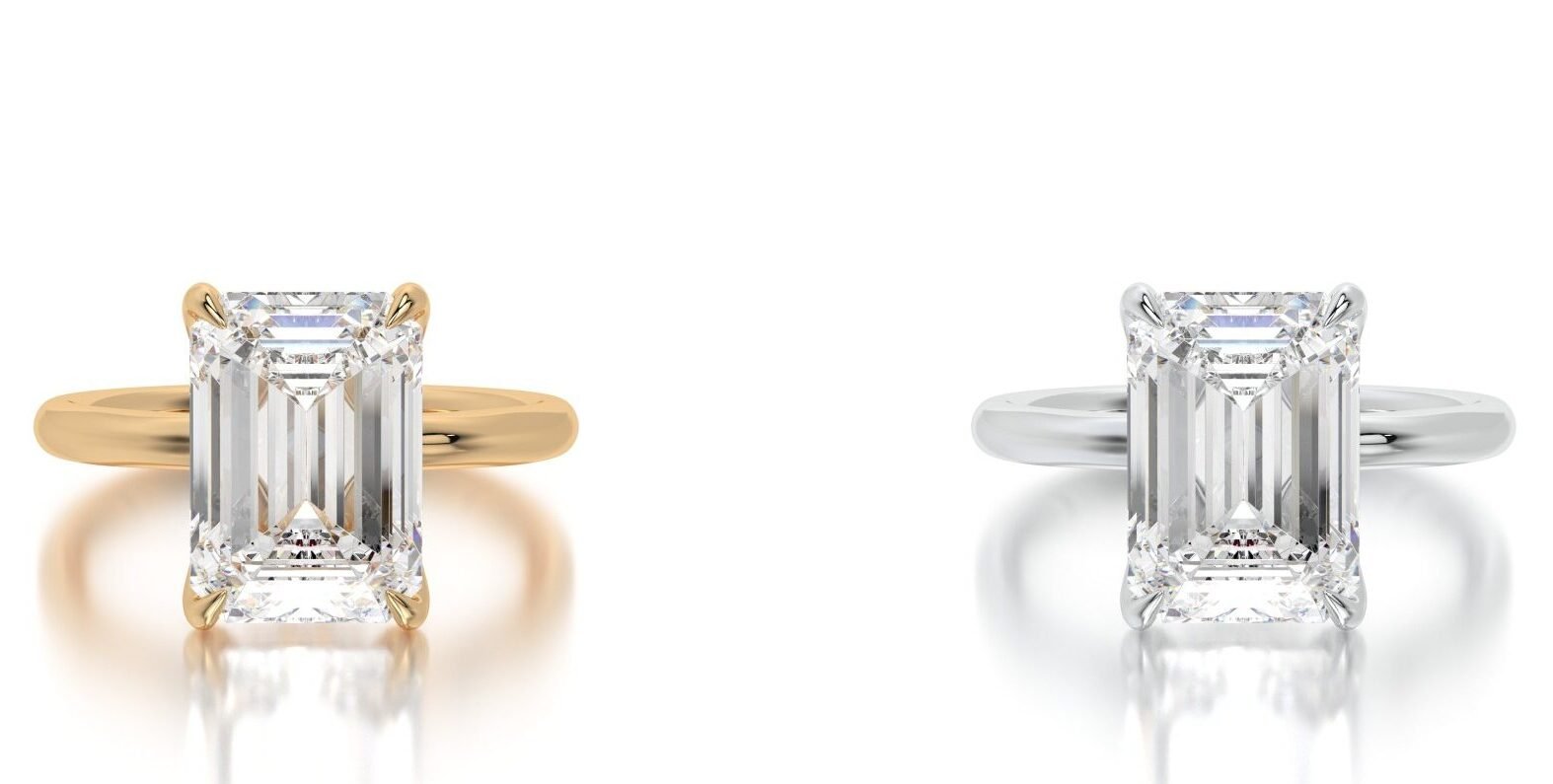
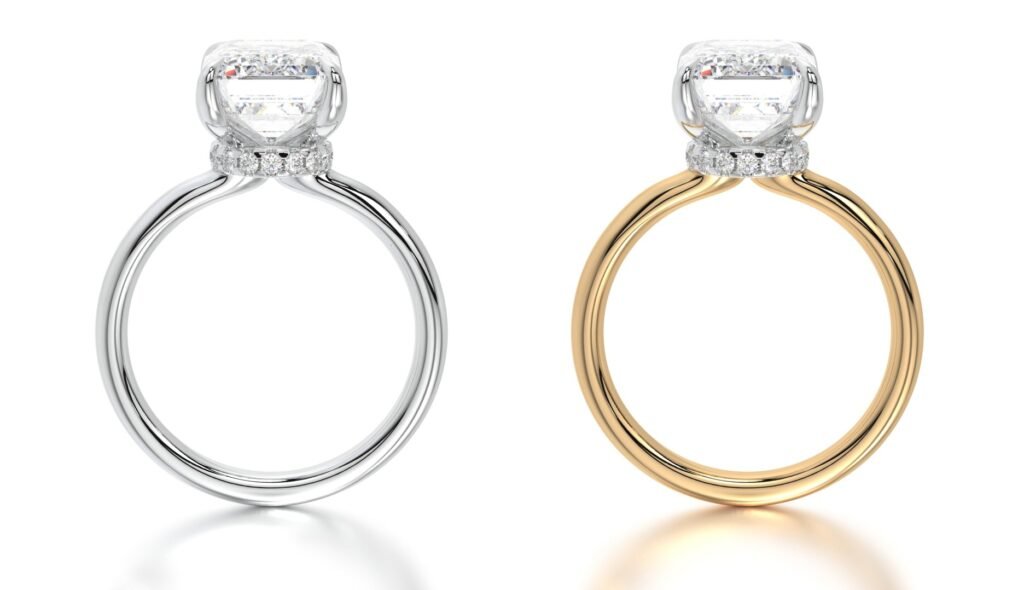
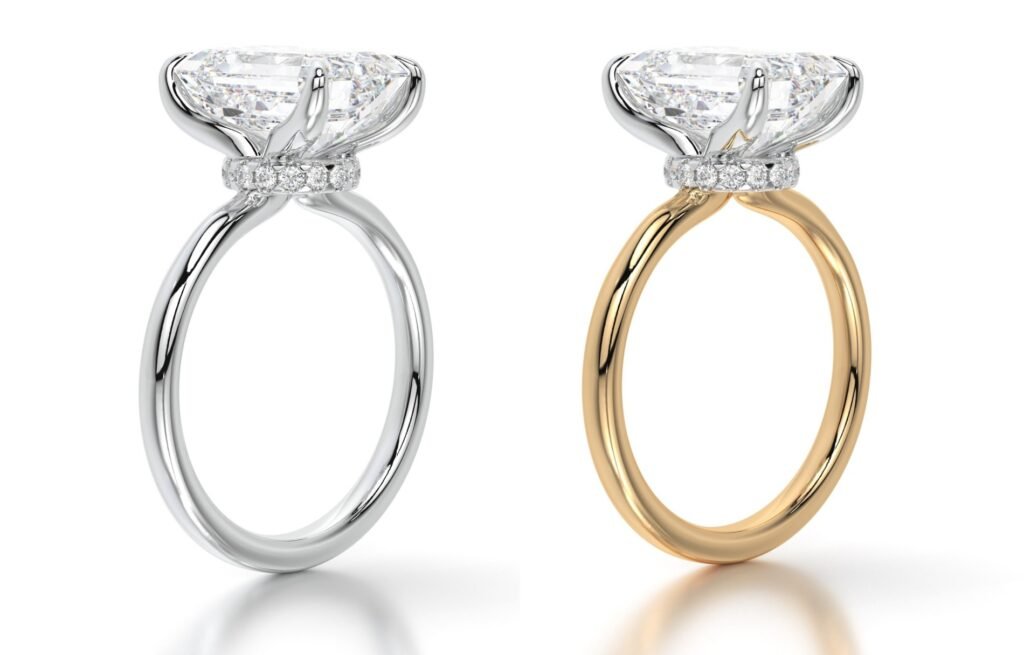
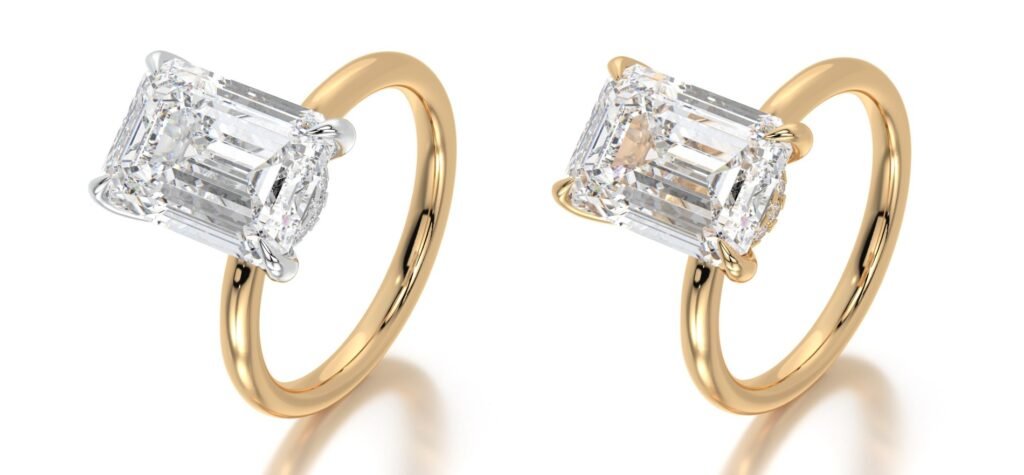
A recent Carl Blackburn custom engagement ring makes the point well. Before any metal was cast, the client reviewed photorealistic CAD renderings showing the same design with an all-white treatment, an all-yellow treatment, and a two-tone combination of a yellow-gold shank and white-metal head.
Seeing the options side by side let the couple compare more than color — they could see how each treatment changed the relationship between band, setting, and a 4.02-carat emerald-cut diamond.
They landed on a warm yellow-gold shank paired with a contrasting white-metal head, a two-tone call that served both the stone and the overall design.
Begin With the Ring, Not a Rule
Ask most San Diego jewelers and they’ll tell you the same thing: there’s no single “best” metal for an engagement ring. It depends on the wearer, the design, and what matters most in daily wear.
The Gemological Institute of America recommends weighing a metal’s inherent qualities rather than picking on color alone. Jewelers typically ask about lifestyle, tolerance for upkeep, budget, and what the wearer already reaches for in their jewelry box.
Someone who wants a naturally white metal with little color maintenance is going to land somewhere different than someone chasing a lighter ring, a lower price point, or gold’s unmistakable warmth.
Before comparing metals, consider four questions:
- What color looks and feels most natural on the wearer?
- How should the metal interact with the center stone?
- How much maintenance is acceptable?
- What wedding band will eventually sit beside the ring?
Answering these turns metal selection into a design decision, not a trend decision.
Yellow Gold: Warmth, History, and Visual Contrast
Yellow gold is the traditional jewelry color largely because it keeps the warm character of gold itself. Pure 24-karat gold is too soft to hold up in most engagement rings, so it’s alloyed with other metals for strength and durability. Fourteen-karat gold runs 58.5 percent gold; 18-karat gold, 75 percent. The specific alloy behind that karat number affects color, hardness, and wear, which is why two rings stamped with the same karat can still look and behave differently.
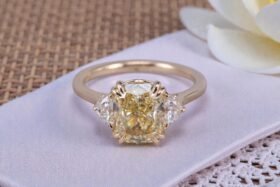
Yellow gold’s appeal isn’t purely nostalgic, either. Designers lean on its warmth for contrast. Set against a colorless diamond, yellow gold can make the stone look noticeably cooler and brighter. It also gives sculptural bands more visual weight, since the eye picks up the gold as its own design element rather than an extension of the diamond.
Maintenance tends to be simple, because the color is baked into the alloy rather than applied as a surface plating. It will scratch and show wear like any precious metal, but it can be polished and repaired by a jeweler. Fourteen-karat yellow gold is often the pick when durability and cost matter most; 18-karat has more pure gold and usually a richer color, but it’s softer.
On the Carl Blackburn ring we’re discussing, an all-yellow version gave the design a unified, luxurious warmth — the flowing shank, rising shoulders, prongs, and hidden halo all read as one continuous golden form. It was a striking option. But it also put warm metal directly against the E-color diamond.
That proximity isn’t trivial. Diamonds pick up some color from their surroundings, especially through the sides and lower facets. A warm setting can introduce a bit of that warmth into the overall look. Plenty of people want exactly that contrast. But for a near-colorless or colorless stone chosen partly for its icy appearance, a white head keeps the visual field around it neutral.
White Gold Rings: A Bright Look
White gold isn’t naturally white the way platinum is. It starts as gold alloyed with white metals — often nickel or palladium, along with others — and it’s one of the more affordable white-metal options on the market. Most commercial white gold also gets a rhodium plating to achieve the bright, mirror-like finish buyers associate with it.
That finish cuts both ways. Rhodium gives the ring a sharp, polished surface, but the plating wears down over time. How fast depends on body chemistry, lifestyle, how the ring is built, and how often it’s worn.
Replating is a normal part of owning a white-gold ring for most people, though there’s no honest one-size-fits-all schedule — some rings need it sooner, some later, regardless of what a retailer suggests.
For someone who wants a bright white look without platinum’s weight or price tag, white gold is a solid choice. Fourteen-karat white gold is common in engagement rings partly because its higher share of alloying metal can make it harder than 18-karat. Alloy formulas vary widely, though, so hardness alone doesn’t tell the full story of how a ring will hold up.
Rendered entirely in white metal, the Carl Blackburn ring took on a cool, seamless, modern look. However, the band visually disappeared into the E-color center stone (see image below), letting the emerald cut’s long step facets and mirrored flashes take over. It was restrained and architectural — just not the warmth this particular couple wanted the ring to carry.
Platinum: Naturally White, Dense, and Distinctive
Platinum is naturally white and typically used at high purity, often 90 to 95 percent. It’s density and strength are reasons it works so well for engagement and wedding rings.
The metal itself feels substantial. Its density makes a platinum ring noticeably heavier than a comparable gold one, which some wearers read as luxurious and permanent, and others simply find heavy compared to gold.
How platinum ages gets oversimplified a lot. It isn’t scratch-proof. Over time it develops a soft, satiny patina, and when it does scratch, the metal tends to displace rather than being lost to the same degree as gold.
White gold, depending on the alloy, may resist fine scratching differently, but it can lose rhodium plating and small amounts of material over the years. Platinum’s real advantage isn’t staying mirror-polished forever — it’s staying naturally white and aging predictably as a long-term jewelry metal.
Some people love the evolving patina and leave it alone; others have it polished periodically. It typically costs more than gold, driven by its density, purity, and the specialized labor it takes to work with. A fair price comparison should account for the finished ring and its upkeep, not just the raw metal price per ounce.
For rings with a prominent center stone, platinum often shows up in the head or prongs even when the shank is gold. Platinum Guild International actively promotes pairing a platinum crown with a yellow- or rose-gold band for clients who want warmth in the ring but a naturally white setting around the stone.
The exact alloy used for the Carl Blackburn ring’s white head would be confirmed in the final fabrication specs, but the design logic holds either way: keep the metal touching the diamond cool and neutral.
Rose Gold: Romantic Color With Its Own Alloy Character
Rose gold gets its blush from copper in the alloy — more copper, deeper rose tone, with the final formulation and karat shaping both color and durability. Like yellow gold, it typically doesn’t rely on rhodium plating for its color.
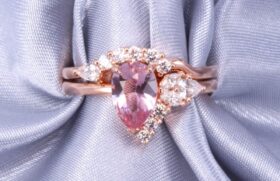
San Diego jewelry designers often bring up rose gold when a client wants warmth without going fully traditional. Its muted pink can flatter a wide range of skin tones, soften an angular design, and pair beautifully with pink diamonds, morganite, and other warm-toned stones. Set against a white diamond, it creates a deliberate contrast.
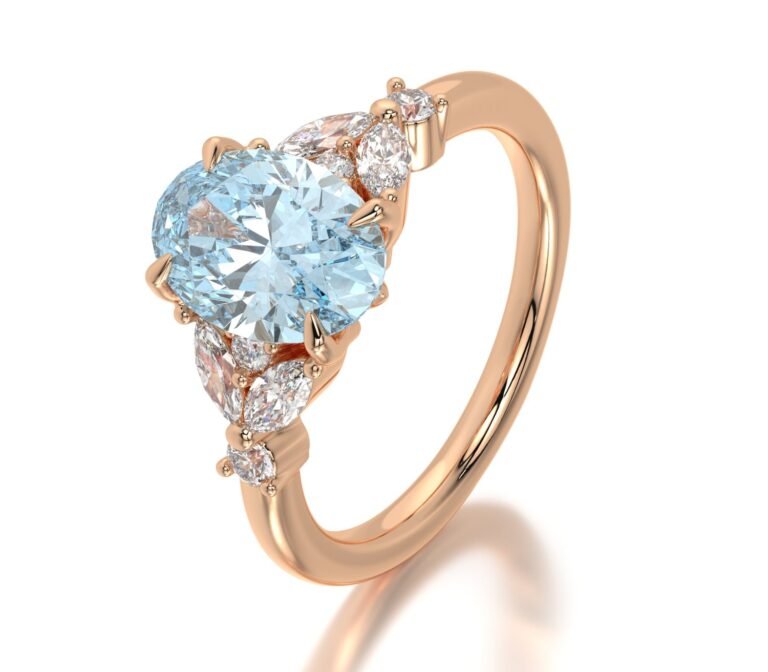
In this Carl Blackburn design, a rose-gold version would have shifted the ring’s whole mood. The sweeping shoulders and hidden halo would soften into something more romantic, while the emerald-cut center stayed just as commanding. But this wasn’t an aesthetic the couple wanted.
It’s a good reminder that a metal that looks appealing on its own can change a specific ring’s personality more than expected.
Why Two-Tone Often Solves More Than One Problem
Two-tone jewelry gets dismissed sometimes as a compromise, but in custom work it’s often the more precise solution — it lets different parts of the ring do different visual jobs.
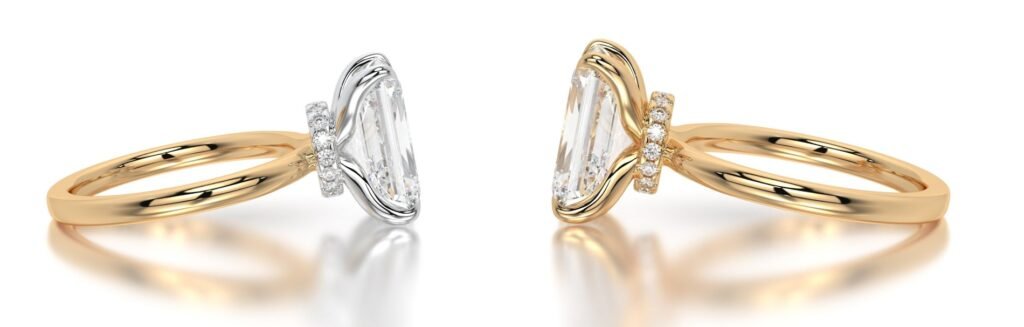
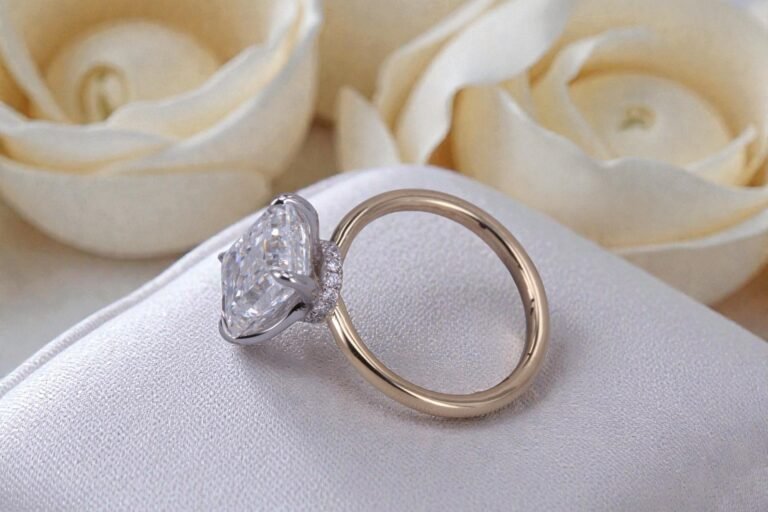
In the couple’s final Carl Blackburn design, the yellow-gold shank carries the warmth and definition, making the band’s sculptural rise easy to read and giving the ring a classic richness. The white-metal head, prongs, and hidden halo frame the 4.02-carat, E-color, VVS-clarity, GIA-certified lab-grown emerald-cut diamond with something cooler (see left side image above).
From above, the white prongs blend into the diamond instead of interrupting its strong rectangular line. From the side, the contrast shows the construction and turns the hidden halo into a glowing transition between head and band.
The pairing works especially well for an emerald cut. A round brilliant is built for scintillation; an emerald cut relies on long step facets, broad flashes, and a disciplined hall-of-mirrors effect — its beauty is about clarity and proportion. The cool head reinforces that crispness, and the yellow shank keeps the ring from feeling cold overall.
Two-tone construction also gives the wearer more flexibility down the line. The ring can sit comfortably next to both yellow- and white-metal jewelry, and either color can be picked up again in the wedding band — not necessarily to match everything, but to build an intentional relationship between the pieces.
How Photorealistic CAD Makes the Decision More Concrete
Custom jewelers used to ask clients to imagine a finished ring from sketches, wax models, loose stones, and small metal samples. Those tools still have their place, but modern CAD adds something they couldn’t: the ability to study the proposed ring in detail, from every angle, before any metal is cast or stone is set.
CAD starts as an engineering tool — it nails down dimensions, stone seats, prong placement, band thickness, clearances, and how the engagement ring will sit next to a future wedding band. Software like Gemvision’s MatrixGold was built specifically for jewelry customization and manufacturing.
Rendering takes that digital model and turns it into a photorealistic image. The client can see the exact same approved geometry in white gold or platinum, yellow gold, rose gold, or a two-tone mix. Because the design itself doesn’t change, the effect of metal color becomes much easier to isolate — the couple isn’t comparing two unrelated sample rings and guessing how their preferred color would translate.
For this ring, the renderings showed not only different overall colors, but different relationships between the head and the band:
- In the all-white version, the shank, rising shoulders, hidden-halo setting, basket, and prongs formed one continuous white-metal design.
- In the all-yellow version, those same components were shown entirely in yellow gold, giving the ring a warmer and more unified appearance.
- In the two-tone version, the shank and shoulders remained yellow gold, while the complete head — including the hidden-halo setting, basket, and prongs — changed to white metal.
The two-tone renderings made the transition especially clear from the side and profile views. The yellow-gold shoulders rise toward the diamond and meet the white hidden-halo setting beneath it. Above that point, the basket and prongs remain white, creating a cool frame around the center stone while allowing the band to retain its warmth.
Photorealistic renderings are still design visualizations, not exact previews. Screen calibration, virtual lighting, final alloy composition, polishing, and the diamond’s own optical behavior all affect the finished piece. Their real value is in comparison and sign-off: proportion, construction, and metal placement can all be evaluated before fabrication starts.
Practical Questions to Ask Before Approving the Metal
A good custom jeweler should be able to move from preference to specification. Before signing off on the design, ask:
- Is the gold 14 karat or 18 karat, and why is that purity recommended for this design?
- If the ring is white gold, is it rhodium plated?
- Which metal will be used for the shank, head, prongs, and pavé setting?
- How will the different metals be joined in a two-tone ring?
- What maintenance should be expected, including polishing, replating, and prong inspections?
- Can the ring be resized later, and does the two-tone construction affect that work?
- What wedding-band profiles will sit comfortably beside the setting?
It’s also worth physically trying on rings of similar dimensions in different metals. CAD shows the eye what to expect, but only a real ring on a real hand can convey platinum’s weight or the feel of a particular band width.
The Right Metal Is the One That Completes the Design
Metal choice shouldn’t come down to a skin-tone chart or whatever’s trending. Those can be useful starting points, but an engagement ring outlasts any trend cycle. The better decision weighs aesthetics, structure, maintenance, cost, and how the wearer actually responds to the piece in hand.
The Carl Blackburn emerald-cut ring shows what happens when all of that gets factored in during the design process itself. The couple never had to imagine the same ring in different metals — they could see the alternatives and understand exactly what each one changed.
Their two-tone choice wasn’t just a preference for two colors; it was a deliberate balance of yellow gold’s warmth and sculptural presence against a cool white frame, with a clear line drawn between the ring’s architecture and its extraordinary center diamond.
That’s the real value of working with an experienced designer on a custom ring. The goal isn’t picking a metal off a menu — it’s understanding what that metal can actually do, and choosing the combination where every part of the ring feels intentional.
To explore a custom engagement ring in white, yellow, rose, or two-tone metal, contact Carl Blackburn to discuss the diamond, setting, and photorealistic CAD options before your ring is made.
📞 Call 858-251-3006 or text 619-723-8589.