14 Nov A Scottish Thistle Trilogy Ring by Carl Blackburn
Matching two diamonds to a center stone sounds straightforward—until the right pair cannot be found. For a Scottish client’s custom engagement ring, Carl Blackburn of C. Blackburn Jewelers in La Jolla solved that problem by sourcing larger diamonds and having them recut by hand. The proportions mattered more than preserving their original weight.
The client had chosen a 3.01-carat lab-grown old mine cushion diamond for her trilogy ring. She also wanted the design to honor her Scottish heritage, giving Carl something more personal to work with than the shape and size of the stones.
He found his inspiration in the Scottish thistle. Its form became the basis for the sculpted setting, while an engraved flower and stem flowed down the band. With its antique-style diamonds and pointed, curving metalwork, the ring began to suggest a royal connection: Carl imagined it as an engagement ring Mary, Queen of Scots, might have designed.
Beginning with an Old Mine Cushion Diamond
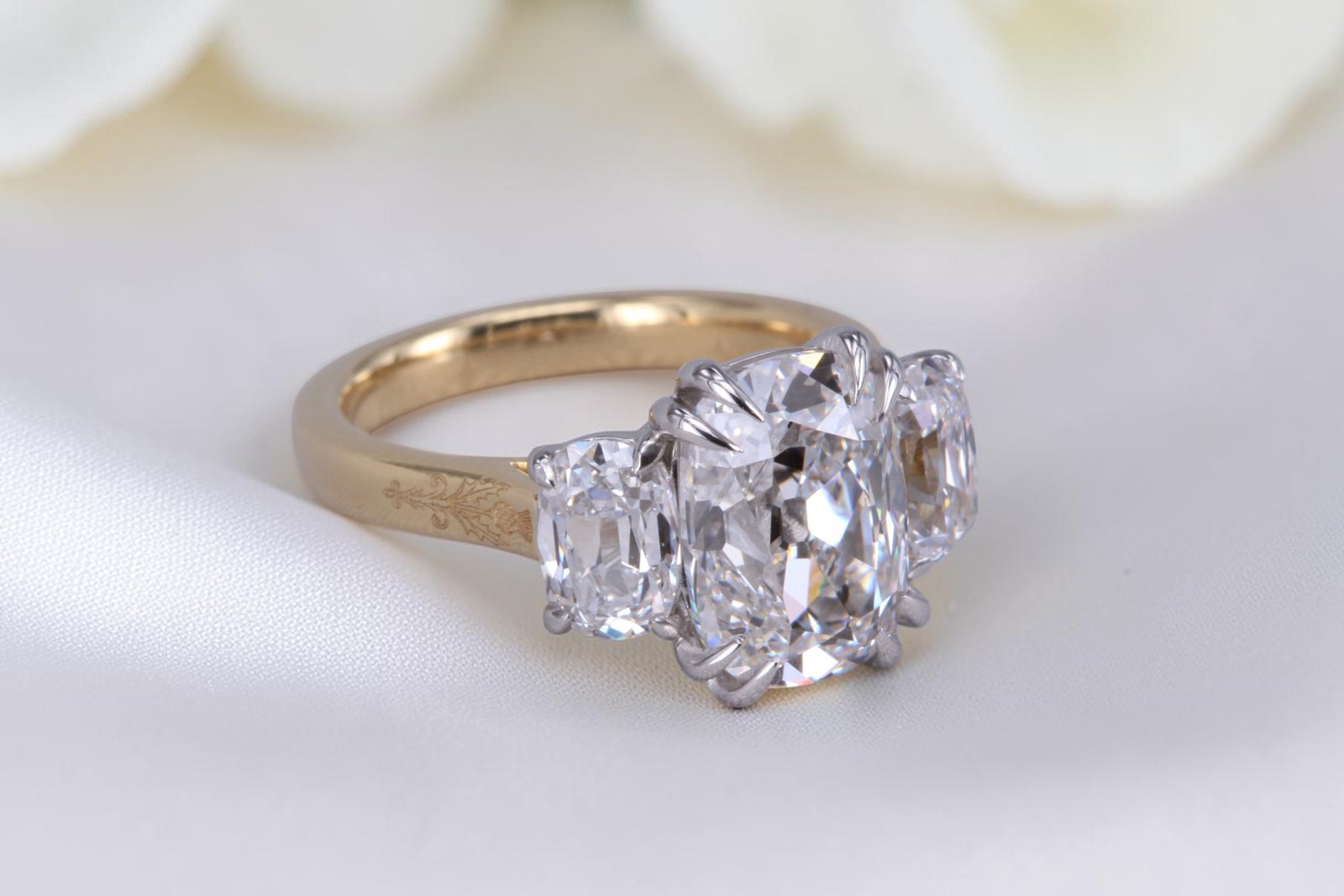
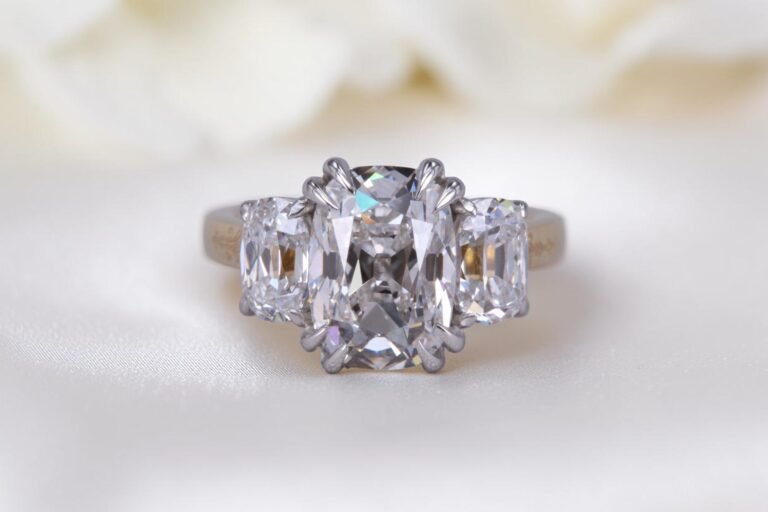
The center diamond’s elongated cushion outline runs along the finger, its rounded corners softening the rectangular shape. Viewed from above, broad facets form a distinct pattern within the stone.
Old mine cuts were especially common from the early eighteenth through the late nineteenth century. Typical characteristics include a relatively small table, a high crown, and a large culet—the small facet at the bottom of the diamond. Their broad facets can produce substantial flashes of colored light.
Here, “old mine” describes the cutting style of a newly created lab-grown diamond. Its shape and faceting give the ring much of its antique character.
Cutting Side Diamonds to Suit the Center
Matching diamonds for a trilogy engagement ring involves more than finding the right carat weights. Their outlines, dimensions, corner shapes, and facet patterns must work together. With this elongated old mine cushion, Carl needed side stones that would echo its proportions on a smaller scale.
“We went out and we found two larger stones,” Carl explains, “and we cut them down by hand to match the center stone perfectly.”
The starting diamonds were approximately one and a half times the weight needed for the finished side stones, leaving material to work with as they were reshaped. Some diamond weight was sacrificed to get the proportions right.
The finished cushions sit closely beside the center diamond, repeating its elongated outline and broad faceting. They step down evenly in size, extending the ring across the finger while keeping the 3.01-carat stone prominent.
Giving the Scottish Thistle a Structural Role
The thistle’s place in Scottish imagery extends back centuries. The National Trust for Scotland notes that it appeared on silver coins issued by James III as early as 1474. Its flower head and pointed leaves also offered Carl shapes he could adapt to a diamond setting.
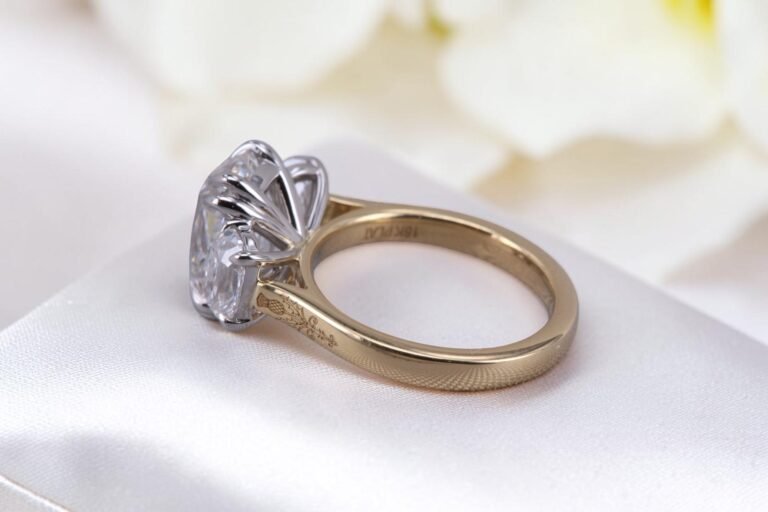
In profile, the polished supports rise and spread toward the diamonds like the structure surrounding a thistle flower head. Open spaces between them make the curves easy to see.
Paired claw prongs frame the center stone’s corners. Their tapered tips suggest the pointed parts of the thistle, adding a sharper edge to the rounded cushion outline. The flower’s influence is clearest from the side, where the full shape of the setting comes into view.
A Thistle Motif Along the Band
On the band, the thistle appears as an engraved botanical drawing. The flower head sits near the diamonds, followed by pointed leaves, curls, and a slender stem extending down the shoulder.
The flower occupies the wider area beside the setting, with the stem narrowing as it runs down the shank. Fine lines define the flower head and leaves, rewarding a closer look.
The rest of the band is left polished and uncluttered, so the small engraving remains easy to read.
The yellow band also contrasts with the white metal around the diamonds. This two-tone treatment gives the engraved shoulders warmth while keeping the prongs visually close to the stones they hold.
Allowing a Companion Band to Sit Flush
Carl positioned the three diamonds just high enough to allow a wedding band to sit flush against the engagement ring. The clearance beneath the projecting settings gives the neighboring band room to fit.
Open shoulders connect the raised settings to the yellow band. From the side, the space beneath the diamonds keeps the ring from looking heavy despite the size of its center stone. This construction also allows the wearer to add a companion wedding ring.
The Mary, Queen of Scots Connection
Carl’s comparison to Mary, Queen of Scots, draws on the ring’s regal appearance and Scottish symbolism. Mary herself, raised at the French court, developed a taste for sumptuous clothing and jewels. National Museums Scotland describes jewelry as an essential part of royal display in her world, as well as a source of wealth that could be sold or pledged when needed.
Her jewels also carried personal significance. National Records of Scotland preserves an inventory that Mary annotated before the birth of her son, identifying beneficiaries for pieces in her collection should she and the child die. The inventory records the personal attachments behind a royal collection.
The connection is imaginative rather than a reproduction of a period jewel. Mary lived from 1542 to 1587; old mine cuts became widespread later. Carl combines the Scottish royal association with a diamond style from subsequent centuries, invoking what he sees as Mary’s independent spirit.
A Custom Ring Built Around Personal Meaning
To create a custom engagement ring that reflects your heritage, favorite design period, or personal story, schedule a consultation with Carl Blackburn at C. Blackburn Jewelers in La Jolla. Bring your ideas and inspiration, and begin exploring the stones, proportions, and details that will make the ring your own.
📞 Call 858-251-3006 or text 619-723-8589.