29 Jul Euro Shank Engagement Rings: Form, Balance & Design
Most engagement rings are designed to be read from the top. The center diamond sets the first impression, side stones (if present) widen the composition, and smaller diamonds carry light into the band. The shank — the part that circles the finger — usually stays quiet, and is there to support the design rather than shape it.
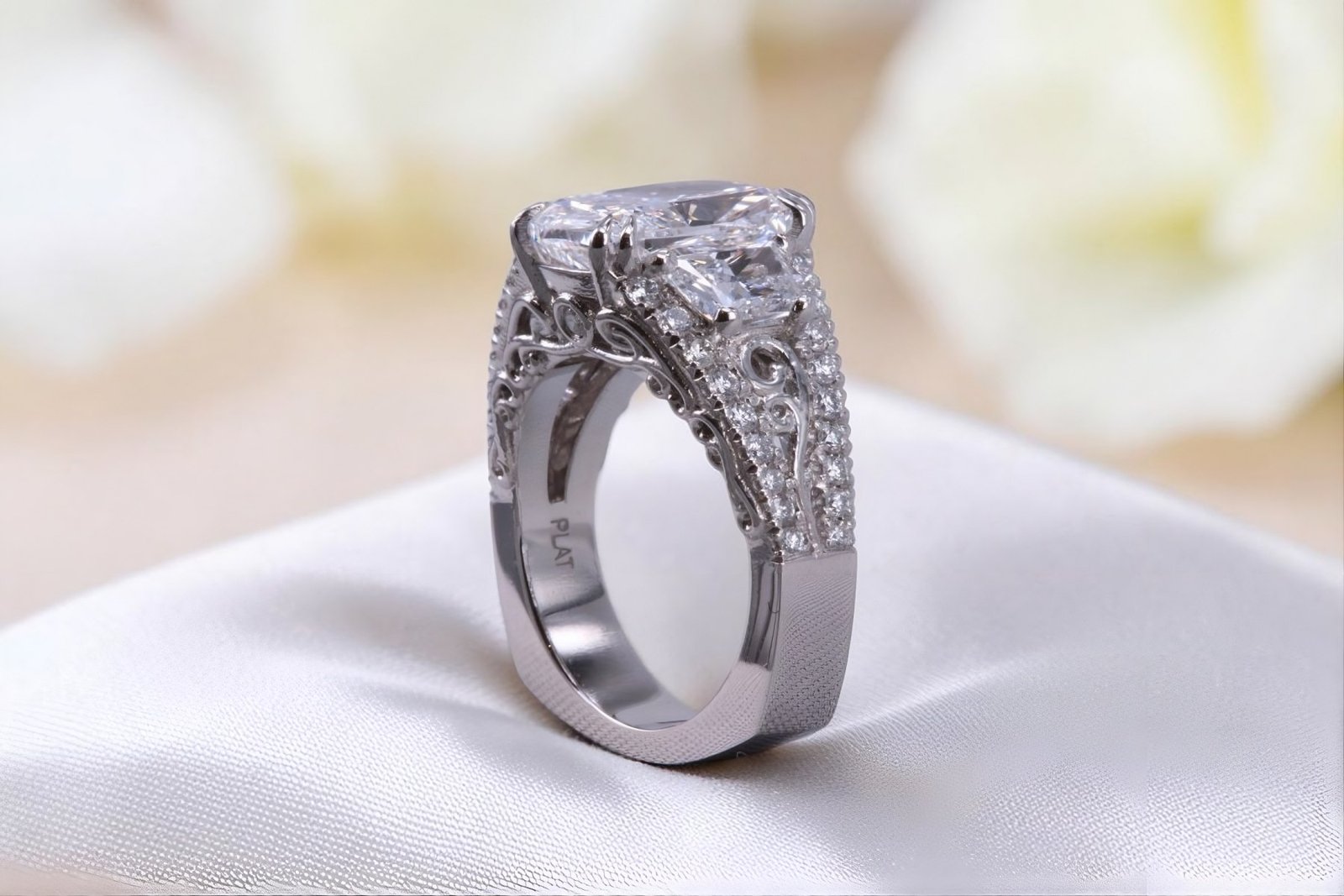
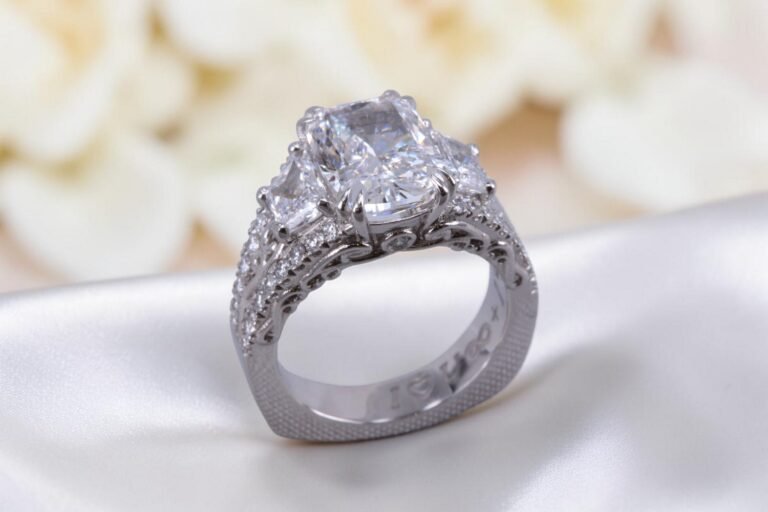
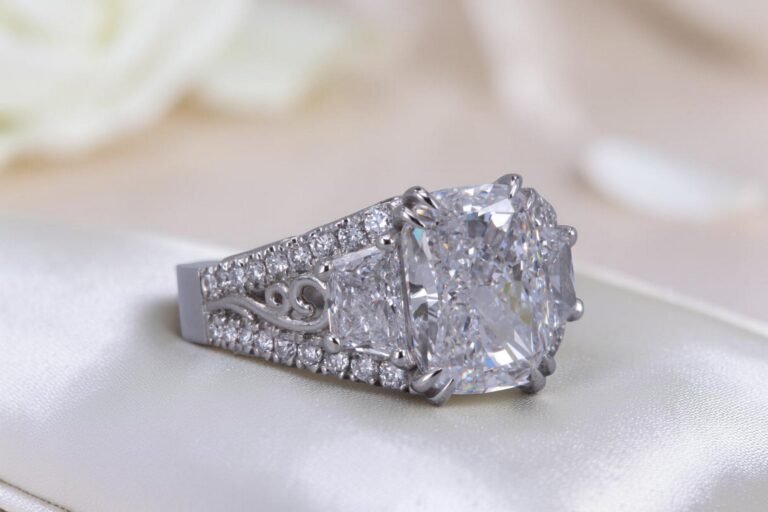
The platinum ring Carl Blackburn created for Stacey and Jason works differently. Its 3.51-carat radiant-cut lab-grown diamond, trapezoid side stones, pavé shoulders, split prongs, and open scrollwork make the upper half unmistakably elaborate. But the feature that gives all of that ornament its physical footing sits lower down: a broad Euro shank with a squared exterior base, built to stabilize a ring whose weight and detail are concentrated up top.
Its proportions affect the shoulders, the gallery, and how the metal is distributed across the whole piece — which makes it worth studying in its own right, not just as a footnote to the diamonds above it.
What Is a Euro Shank?
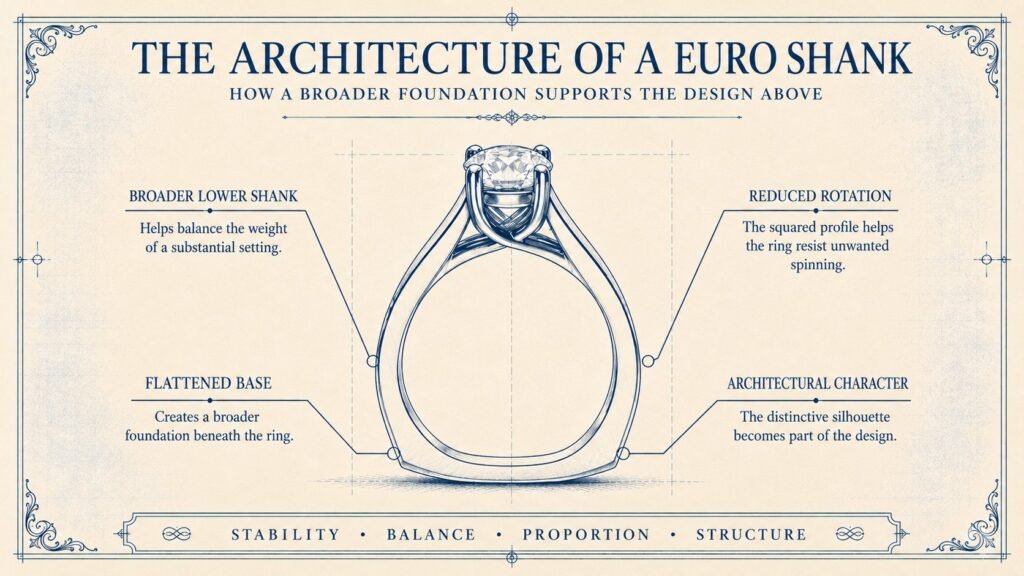
A Euro shank, also called a European shank, replaces a ring’s continuously rounded exterior with a flatter, more squared bottom. Some versions are only gently flattened; others have sharply defined lower corners and an almost architectural profile. The interior can stay comfortably curved even as the outside becomes more angular.
The purpose is stability. A large center stone places extra weight above the finger, and a traditionally rounded band is more prone to spin under that weight. Widening and flattening the lower shank creates a broader base that resists rotation, which is why the style shows up so often on large center diamonds, three-stone arrangements, and halos.
That’s precisely the problem Stacey’s engagement ring needed to solve: a 3.51-carat center stone, two substantial trapezoid side diamonds, rows of pavé, split platinum prongs, and a fully developed gallery. A narrow rounded band would have put all of that weight above a comparatively delicate foundation. The Euro shank gives the lower ring enough width and structure to belong to the same composition as the setting above it.
A Shank Built for a Ring With Presence
There’s no single documented inventor of the Euro shank, no patent moment the way there is for a diamond cut. It emerged out of the practical evolution of ring construction — as settings grew larger and more elaborate, the band beneath them could no longer stay a passive circle of metal.
What’s notable in Stacey’s engagement ring is how visible that engineering becomes. The flatter bottom resists movement, but it also changes how the ring reads off the hand. Instead of tapering into an ordinary band, it finishes in a broad, squared base that gives the piece a grounded stance — most apparent in the side and rear views, where the ring doesn’t look balanced precariously on its setting so much as standing on it.
That solidity also makes the transition from the ornamented shoulders to the lower band feel intentional. The diamond-set upper section doesn’t simply taper until the decoration runs out; it meets a shank substantial enough to carry the scale of everything above it.
The Radiant Cut and the Architecture Above the Shank
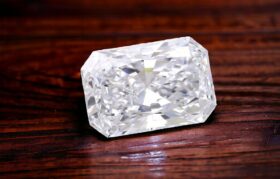
At the center of the ring is a 3.51-carat, D-color, VVS-clarity lab-grown radiant-cut diamond. The radiant cut was developed in the late 1970s by diamond cutter Henry Grossbard, who wanted brilliant-style light performance in a square or rectangular outline with clipped corners — combining architectural geometry with a livelier scatter of light than the broad, linear flashes typical of an emerald cut.
From a distance, the center stone reads as a strong rectangle with softened corners. Up close, its facets break light into flashes moving in several directions. Rather than quiet that activity, Carl built the ring outward from it.
The trapezoid-cut side diamonds pick up the center stone’s geometry, broadening the top of the ring without breaking its angular language — their tapered outlines pull the eye from the radiant-cut center toward the shoulders, so the three major diamonds read as one expanding composition rather than three separate stones.
The Euro shank closes that progression at the opposite end: a broad rectangular diamond at top, tapered trapezoids and widening pavé through the middle, and a flattened lower base to finish. The geometry shifts from section to section, but never arbitrarily.
Why the Trapezoids Matter
Trapezoid diamonds are often used as transitional stones — their wider edge meets a center diamond while the narrower edge points toward the band, letting a large rectangular center stone move naturally into a more tapered ring.
Here they do more than fill space. Their size gives the center diamond visual support, and their angled sides begin the outward movement the shoulders continue. They also keep the 3.51-carat radiant from looking like it was simply mounted onto the band rather than integrated into it, creating an intermediate scale between the dominant center stone and the smaller round diamonds below.
That geometry reinforces the logic of the Euro shank, too: the ring is broad and diamond-intensive at the top, so the squared lower band reads as proportionate rather than heavy.
Split Prongs and the Framing of the Center Diamond
The center diamond is held by divided platinum prongs rather than a single prong at each clipped corner — a choice that gives the setting more visual weight and a more elaborate frame. A conventional single-prong arrangement would likely have looked too slight next to the trapezoid diamonds and heavily detailed shoulders. Split prongs have enough substance to hold their own in that company, but because each corner is carried by two narrow points rather than one broad mass of metal, most of the diamond stays visible.
They also echo the ring’s larger structure: just as the shoulders divide into multiple diamond-set borders and scrollwork, each corner support splits into paired prongs. It’s not decoration for its own sake — like the Euro shank, the prongs solve a practical problem while adding to the ring’s overall architecture.
Art Nouveau Beneath a Geometric Diamond
The upper view of Stacy’s ring is dominated by straight edges, clipped corners, and tight symmetry. Underneath, the character shifts. Carl filled the gallery and shoulders with open platinum scrollwork — curved forms that sweep inward, divide, and curl back on themselves beneath the diamonds — recalling the flowing “whiplash” line associated with Art Nouveau, the movement that carried asymmetrical curves through architecture, metalwork, and jewelry around the turn of the twentieth century.
The reference isn’t literal; the ring is more symmetrical and diamond-focused than most historical Art Nouveau pieces. But the open curves do the same visual job: they make rigid material appear to move. That matters because nearly everything above the scrollwork is geometric — the radiant center, trapezoid sides, squared shank, and parallel pavé rows could easily have added up to something severe.
The scrollwork softens those lines without weakening them, so the ring reads as brilliant and architectural from the front, and lighter and more ornamental from the side.
Platinum as Structure and Ornament
Openwork like this asks the metal to do several jobs at once: secure major diamonds, support the shoulders, preserve the negative space inside the scrolls, and stay refined enough not to overwhelm the stones. Platinum’s strength is what allows jewelers to build delicate structures while still holding valuable stones securely, which is part of why it became closely tied to intricate diamond jewelry and openwork in the late nineteenth and early twentieth centuries.
In this engagement ring, the metal shifts between apparent lightness and obvious mass — carved into narrow scrolls near the gallery, drawn into precise prongs and borders around the diamonds, and gathered into a broad, solid shank at the base. Ornament gradually becomes support rather than existing as a separate layer on top of it.
Pavé Shoulders and the Control of Abundance
Small round diamonds run along the shoulders in multiple rows, creating a field of brilliance beside the three larger stones. Their job isn’t to compete with the center diamond — it’s to carry its light outward, following the rising borders of the ring and emphasizing the movement from shank to setting. Because the rows sit inside clearly defined platinum edges, the effect feels abundant rather than cluttered.
The open scroll at the center of each shoulder does real work here too. Without it, the upper shank could easily have become a solid field of diamonds; instead, Carl removes metal and opens up space exactly where the design could have felt heaviest — dense pavé framing open scrollwork, angular diamonds sitting above curving metal, a broad base supporting a gallery that still reads as light.
Why the Euro Shank Belongs to This Design
The squared lower outline of the Euro shank repeats the architectural character of the radiant-cut center — both are essentially rectangular forms softened at the corners, one setting the ring’s dominant geometry at the top, the other quietly restating it at the bottom. The shank’s width also makes the upper design credible: a 3.51-carat center, two trapezoids, extensive pavé, split prongs, and an intricate gallery need a base with comparable authority, or the setting would look oversized for the band carrying it.
Carl left the lower shank free of diamonds, letting the platinum itself become visible again after the intensity of the shoulders. A fine textured finish on the outer lower shank sets it apart from the polished inner surface and the reflective diamonds above — a quieter area, but not an absence of design. It gives the eye somewhere to rest, and it’s what makes the shank’s unusual outline legible in the first place.
A Ring Considered From Every Angle
From above, the radiant and trapezoid diamonds form a broad, brilliant three-stone composition. At an angle, the divided prongs and layered pavé borders come into focus. From the side, the scrollwork shows how much ornament sits beneath the diamonds. From the rear, the Euro shank changes the ring’s entire silhouette. Each view tells a different part of the same story — one built from the bottom up as much as from the top down.
Stacey’s custom ring draws from several eras without imitating any one of them: scrolling openwork that recalls Art Nouveau, platinum construction and geometric diamond arrangement that echo early twentieth-century fine jewelry, a radiant cut that belongs to a much later development in diamond cutting, and a 3.51-carat lab-grown center that gives the design its scale. The result feels historic without being a reproduction — less because of any single vintage detail than because every part was considered in relation to the others.
The center diamond informed the side stones; the side stones informed the shoulders; the upper setting was never built without giving the lower shank enough strength to support it.
The Euro shank will never draw attention as fast as a 3.51-carat radiant cut, and it isn’t meant to. Its job is quieter: keep the ring properly oriented, give the lower band enough substance to balance a diamond-intensive setting, and let the upper half be as elaborate as Stacey and Jason wanted without ever looking unstable.
Create an Engagement Ring Built Around Every Detail
A custom engagement ring should be considered from every angle, including the parts that may not be noticed first. Whether the design calls for an unusual shank, a large center diamond, hand-carved metalwork, carefully matched side stones, or a setting developed entirely around one person’s style, Carl Blackburn can create a ring in which structure and beauty are designed together.
Contact C. Blackburn Jewelers in La Jolla to begin creating a custom engagement ring made specifically for your story, your preferences, and the life you are building together.
📞 Call 858-251-3006 or text 619-723-8589.