14 Jul The Uniqueness of Kite-Shaped Diamond Engagement Rings
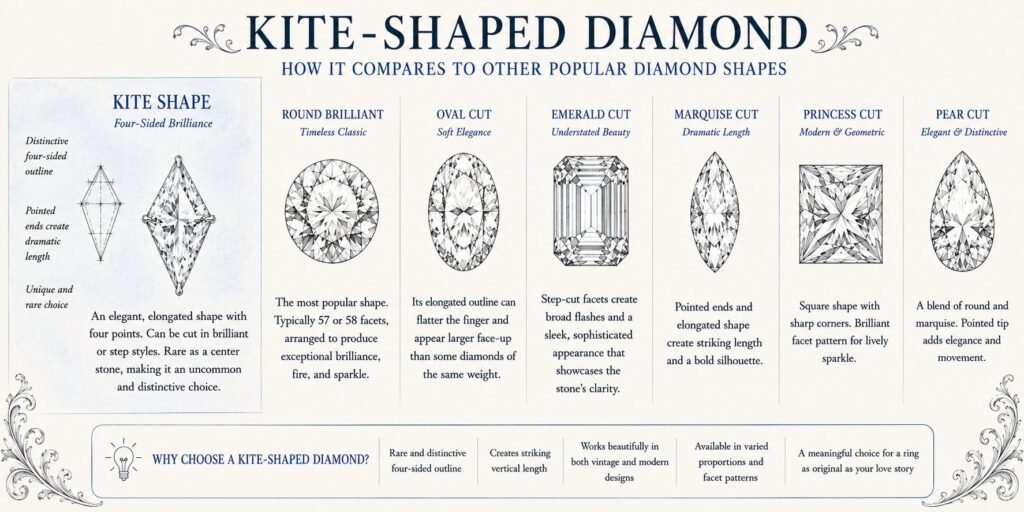
Engagement ring design has, for over a century, been dominated by a short list of diamond shapes: round, oval, emerald, cushion, pear, marquise, princess. The kite-shaped diamond belongs to a smaller, more adventurous category — a four-sided outline, elongated points, strong directional geometry, a look that’s instantly recognizable but rarely seen in a conventional jewelry case.
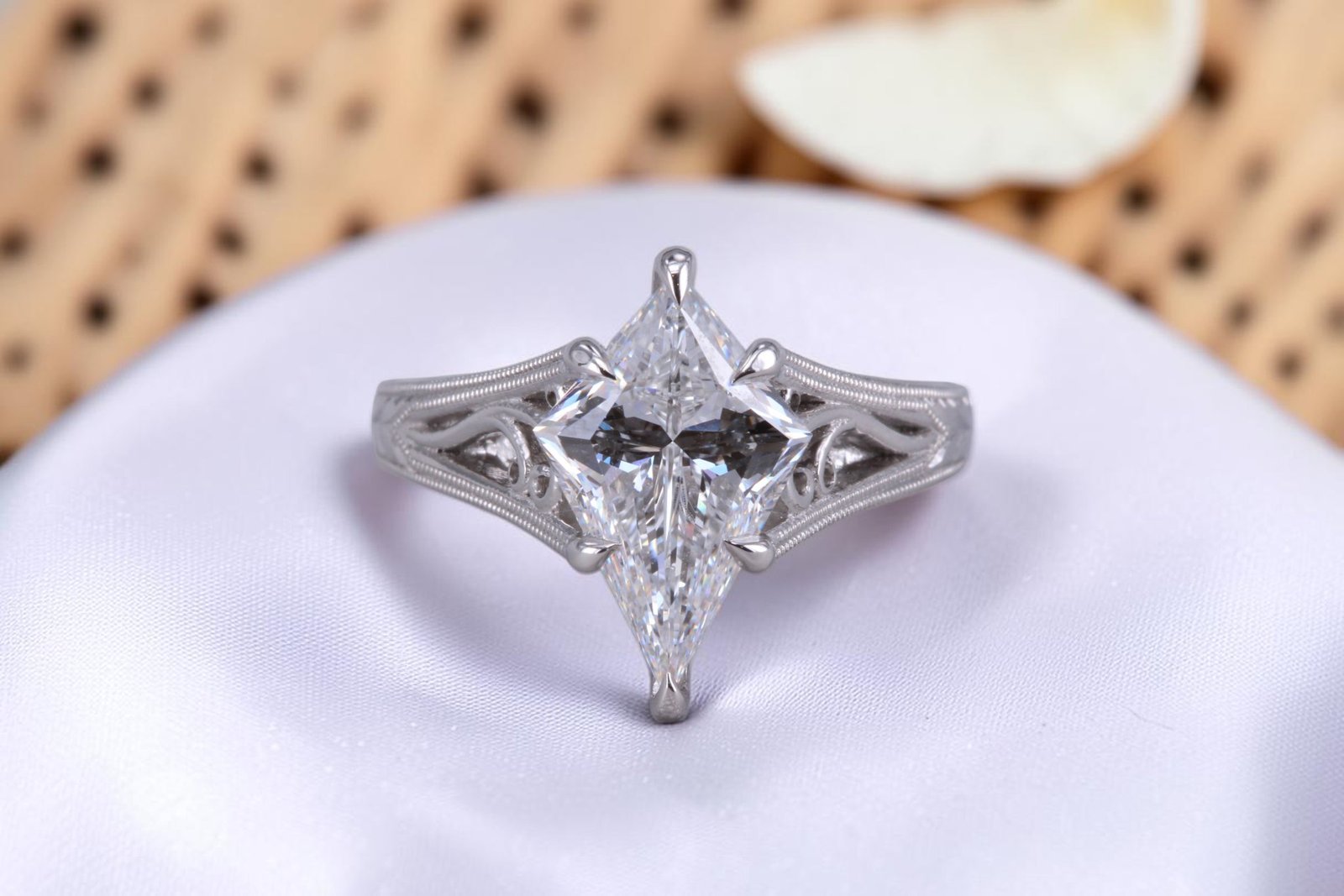
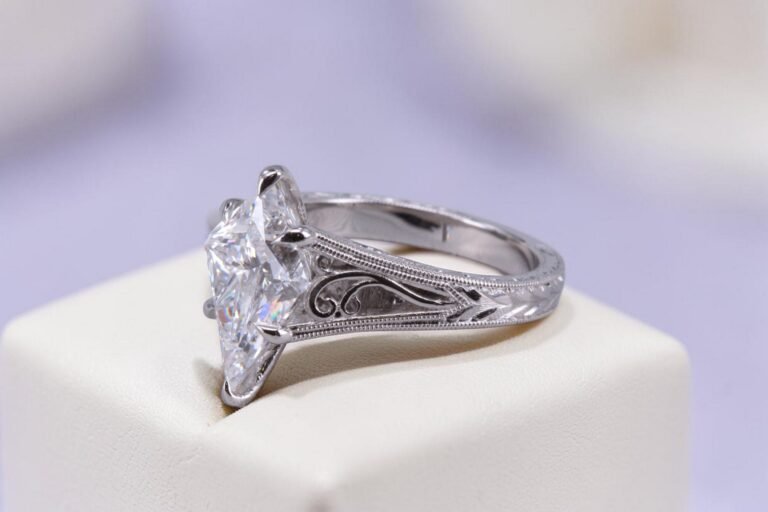
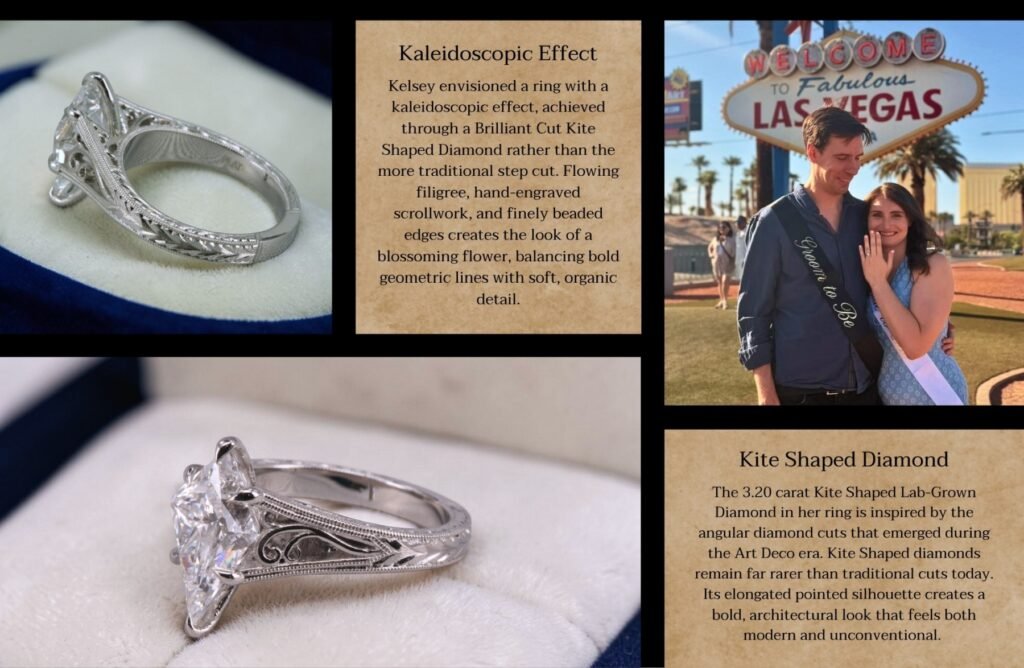
That rarity was the point when Kelsey came to Carl Blackburn of C. Blackburn Jewelers in La Jolla wanting a custom engagement ring with a dramatic, kaleidoscopic center. Carl designed for her a 3.20-carat kite-shaped lab-grown diamond set in platinum and finished with filigree, hand engraving, and beaded milgrain (see photo above).
It’s a useful engagement ring to study because almost every design decision in it answers a question the kite shape has been raising, in one form or another, for a hundred years.
What Is a Kite-Shaped Diamond?
A kite-shaped diamond has a four-sided outline resembling a flying kite: an upper point, a lower point, two side corners. Proportions vary widely — some kites are nearly symmetrical top to bottom, others considerably more elongated, with one point extending further than the other. “Kite-shaped” describes the outline, not one standardized facet arrangement; a cutter might give the stone a step-cut pattern, producing the broad, linear reflections seen in an emerald cut, or a brilliant-style arrangement built for more sparkle and movement.
That second option — brilliant, not step — is what Kelsey’s stone is, and it’s the choice that ends up shaping nearly everything else about her ring: a step-cut kite would have given her the quiet “hall of mirrors” look, but she wanted something closer to a kaleidoscope, which meant more, smaller facets working the light instead of a few broad ones.
Worth Noting: a kite-shaped diamond isn’t the same as a kite-set diamond. A kite-set ring rotates a square stone — princess, Asscher — 45 degrees so a corner points toward the fingertip; the stone itself stays square. Kelsey’s diamond is a true kite from the start, cut with a four-sided kite outline rather than turned into one by orientation.
That also puts it outside GIA’s standardized overall cut-grading system. Gemologists classify any outline other than the round brilliant as a “fancy shape,” and because fancy shapes don’t share the round brilliant’s standardized facet structure, GIA assigns them polish and symmetry grades rather than an overall cut grade. Which means a stone like Kelsey’s succeeds or fails on the cutter’s individual judgment — the balance of the outline, where the table sits, how the upper and lower points relate to each other — with no standardized scale to check the work against.
Geometric Origins, and Where This One Fits
There’s no single inventor or patent behind the kite shape, the way there might be for the radiant cut. Its history sits inside the broader story of geometric diamond cutting: early cutters worked within the constraints of the rough crystal and the pressure to retain weight, and as cutting technology improved, deliberate geometric outlines became possible rather than the stone simply following the rough.
This experimentation crested during Art Deco, the 1920s and ’30s, when jewelry turned away from Art Nouveau‘s flowing naturalism toward symmetry, abstraction, and machine-age geometry. Triangles, trapezoids, baguettes, half-moons, and kite-like diamonds became structural elements in rings and brooches — useful precisely because a tapered outline could fill a sharply angled space, point toward a center stone, or complete a fan or star motif.
For most of the shape’s history, that’s exactly where it stayed: an accent, not the main event, suited to complex hand-built jewelry rather than the standardized mountings that came to dominate later in the century. Kelsey’s ring runs against that history in one specific way — the kite here isn’t filling in around something else. It’s the thing everything else was built to surround, which is a much newer idea than the shape itself.
Platinum, Milgrain, and Building the Setting Around Her Stone
The rise of geometric diamond jewelry tracked closely with the rise of platinum. Its strength let jewelers hold stones securely with very little visible metal, which made Art Deco’s delicate openwork and knife-edge structures possible in the first place; GIA’s own historical research describes platinum and diamonds as foundational to fine jewelry of the period, prized for strength, luster, and the ability to support intricate design, with milgrain — rows of tiny beaded detail along a metal edge — used to sharpen outlines and finish the metal.
Platinum and diamond are doing the same two things in Carl Blackburn’s ring that they did a century ago — one holding, one showing. But the stone’s role has changed: Art Deco jewelers used kite shapes mostly as small accents, while here a 3.20-carat kite carries the ring as its center. That scale puts more weight on platinum’s two strengths. Its white surface doesn’t compete with a colorless diamond’s outline, and it can carry delicate work without adding bulk — both of which matter more, not less, on a stone this geometrically assertive.
But building that setting from scratch raised its own problem. Historically, a small kite-shaped accent could be visually integrated into a larger arrangement, with neighboring stones and surrounding metalwork helping to balance its unusual proportions. Kelsey’s setting had none of that: it had to be built around one stone’s exact outline, depth, and corner positions, with nothing else in the piece to carry the weight.
Carl’s solution was to let the platinum follow the diamond’s own geometry rather than impose a shape onto it: sculpted prongs that secure the vulnerable points and corners while leaving most of the outline exposed, and that — seen from the front — extend the stone’s symmetry straight into the ring’s shoulders, so the prongs read as part of the composition rather than hardware holding it down.
Why the Kite Moved to the Center in the First Place
Kelsey’s ring is also a product of a few more recent shifts that made a kite-as-centerpiece practical at all. Modern measuring and cutting technology gives cutters finer control over unconventional outlines than Art Deco-era tools allowed. San Diego custom jewelers can now build a setting around one specific stone’s measurements instead of forcing it into a prefabricated mounting — which is exactly what Carl Blackburn did here.
Lab-grown diamonds have widened access to larger, more experimental cuts that would be difficult or costly to source from natural rough at 3.20 carats. None of that changes what the kite shape is; it just explains why a stone this size, this shape, ended up as someone’s center diamond instead of an accent around someone else’s.
It also reflects what Kelsey wanted in the first place: a diamond that didn’t need to belong to a familiar category to be right for an engagement ring. The kite works for that ambition because it borrows something from several shapes at once — a marquise’s length and movement, a shield’s crisp geometry, a pointed outline that can read as floral, architectural, or celestial depending on how it’s set.
In Kelsey’s ring it reads as floral: oriented vertically, with its longest points reaching toward and away from the hand, the diamond gives the ring a strong central axis and enough width at the side corners to hold the eye without needing a halo. Set inside Carl’s mirrored, divided shoulders, the stone reads almost like the heart of a blossoming flower, its facets radiating outward — bold, geometric stone against fluid, organic metalwork.
Filigree and Hand-Engraved Detail
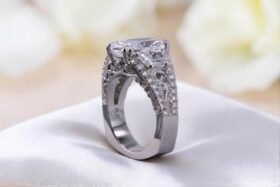
That contrast continues down the rest of the ring. The shoulders are open platinum filigree rather than solid metal, sweeping scrolls curling inward beneath the upper borders and leaving negative space that keeps the profile light despite the size of the center stone. Fine milgrain runs along the raised edges of shoulders and shank, separating one plane of metalwork from the next and pulling the eye back toward the diamond. Hand-engraved, leaf-like cuts continue down the sides of the band, softening toward the lower shank — the detail that keeps a 3.20-carat geometric stone from feeling bolted onto the rest of the ring rather than grown out of it.
Seen from the side, the engineering under all that ornament becomes visible: the shoulders rise to support the center stone, but the openwork keeps the structure from reading as heavy, and the gallery follows the kite’s angles closely enough to leave much of the pavilion exposed. Light and movement stay part of the diamond’s appearance even in profile, and the same structural lines that hold the stone in place double as the scrolls, borders, and leaves that decorate it — form and support are doing the same work.
The Kite Shape Beyond This One Ring
Kite-shaped diamonds turn up elsewhere in engagement rings, earrings, and pendants — smaller kites as side stones smoothing the transition between a center gem and a narrowing band, or arranged into stars, flowers, and wings. As a center stone, the shape suits a range of settings beyond the one Carl Blackburn chose: a minimalist bezel for an uninterrupted outline, a three-stone ring paired with triangles or tapered baguettes, an asymmetrical setting that plays up the shape’s direction.
What Kelsey’s ring represents is one end of that range — one of the more ornamental possibilities, where the geometry is deliberately softened rather than left stark. And like any pointed shape, its corners need the kind of protection a round or oval doesn’t require; a secure setting and periodic inspection matter more here than they do on stones with fewer sharp points to guard.
A Modern Ring with an Heirloom Character
Nothing about Kelsey’s custom engagement ring treats the center stone as a novelty dropped into a standard mounting. The platinum shoulders echo the stone’s taper. The prongs reinforce its symmetry. The filigree softens the visual severity of the diamond’s sharp geometry without disguising or diminishing its distinctive outline. The engraving and milgrain tie a modern brilliant-cut diamond back to a much older tradition of hand-finished jewelry, and the 3.20-carat lab-grown center stone still delivers the kaleidoscopic effect Kelsey set out to find in the first place.
The kite-shaped diamond will likely never be as common as the round brilliant or the oval, and that’s largely the point. It carries a long thread of geometric experimentation — from Art Deco’s angular compositions to a custom ring built a century later — and in the hands of a San Diego custom jeweler willing to build the setting around it, it offers something the familiar shapes can’t: a center stone that determines its own architecture.
Create a Ring Built Around Your Story
A custom engagement ring should feel as individual as the person who will wear it. Whether you are drawn to an unusual diamond shape, intricate hand engraving, vintage-inspired details, or a completely original design, Carl Blackburn can help turn your ideas into a ring made specifically for you. Contact C. Blackburn Jewelers in La Jolla to begin creating a custom engagement ring that reflects your style, your story, and the future you are building together.
📞 Call 858-251-3006 or text 619-723-8589.