14 Aug The Beauty of Asscher Cut Diamond Engagement Rings
Some diamonds announce themselves through sparkle. An Asscher cut works more slowly. Its clipped corners establish a strong outline, while broad step facets pull the eye inward through a sequence of reflections that seems to recede into the stone.
Two custom engagement rings Carl Blackburn created for Trevor and Courtney, and Michael and Tessa, begin with that same architecture and take it in different directions.
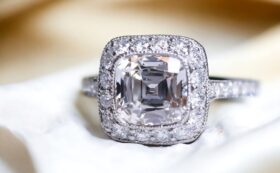
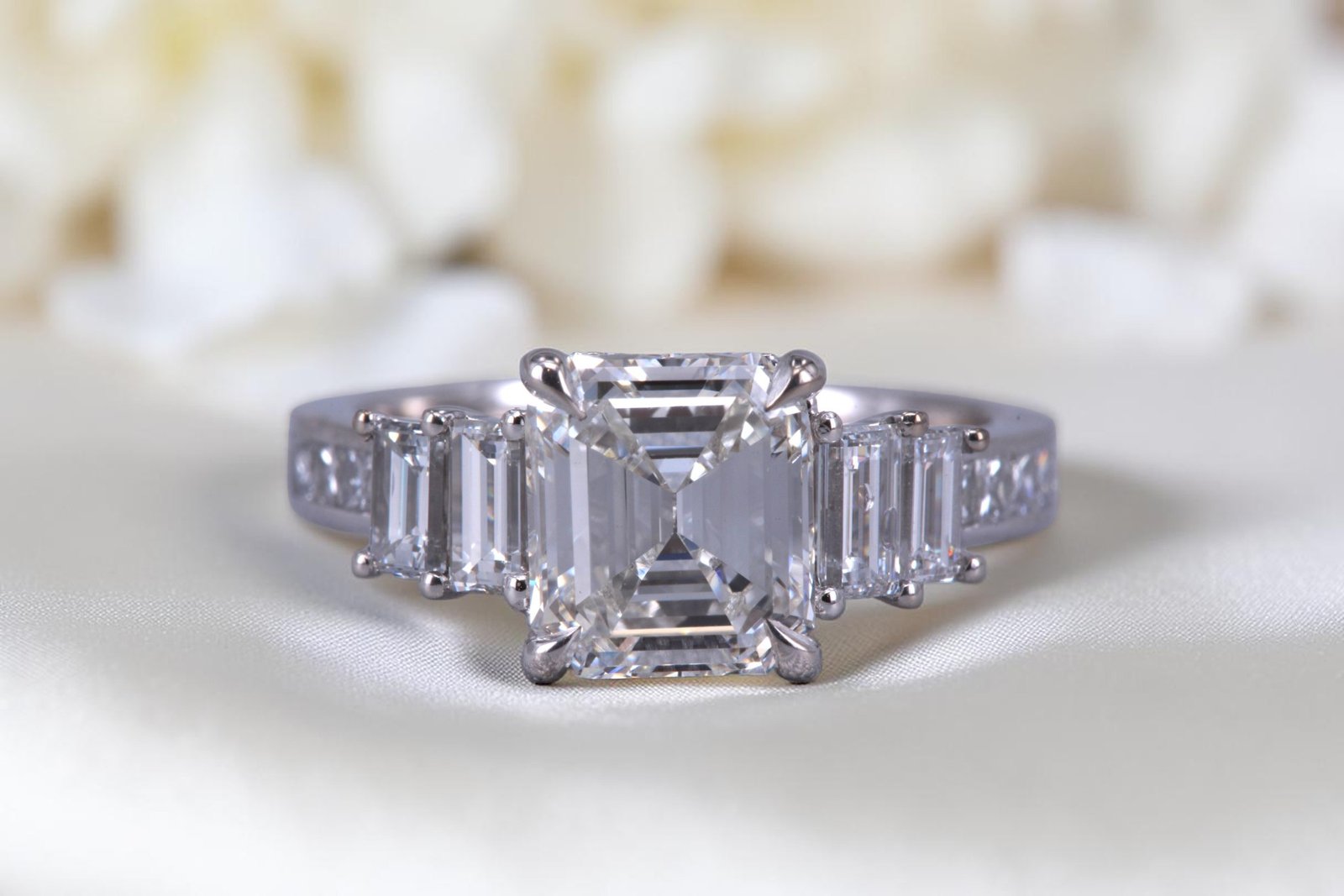
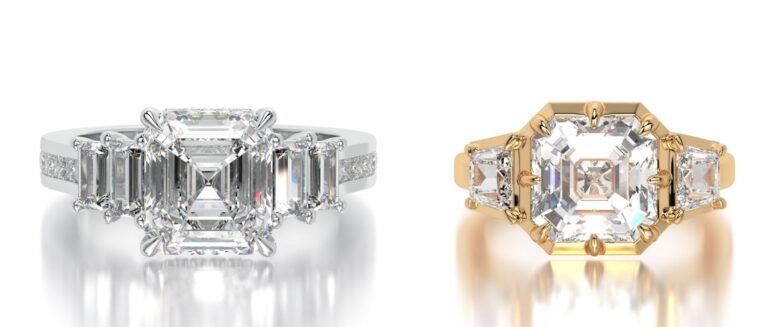
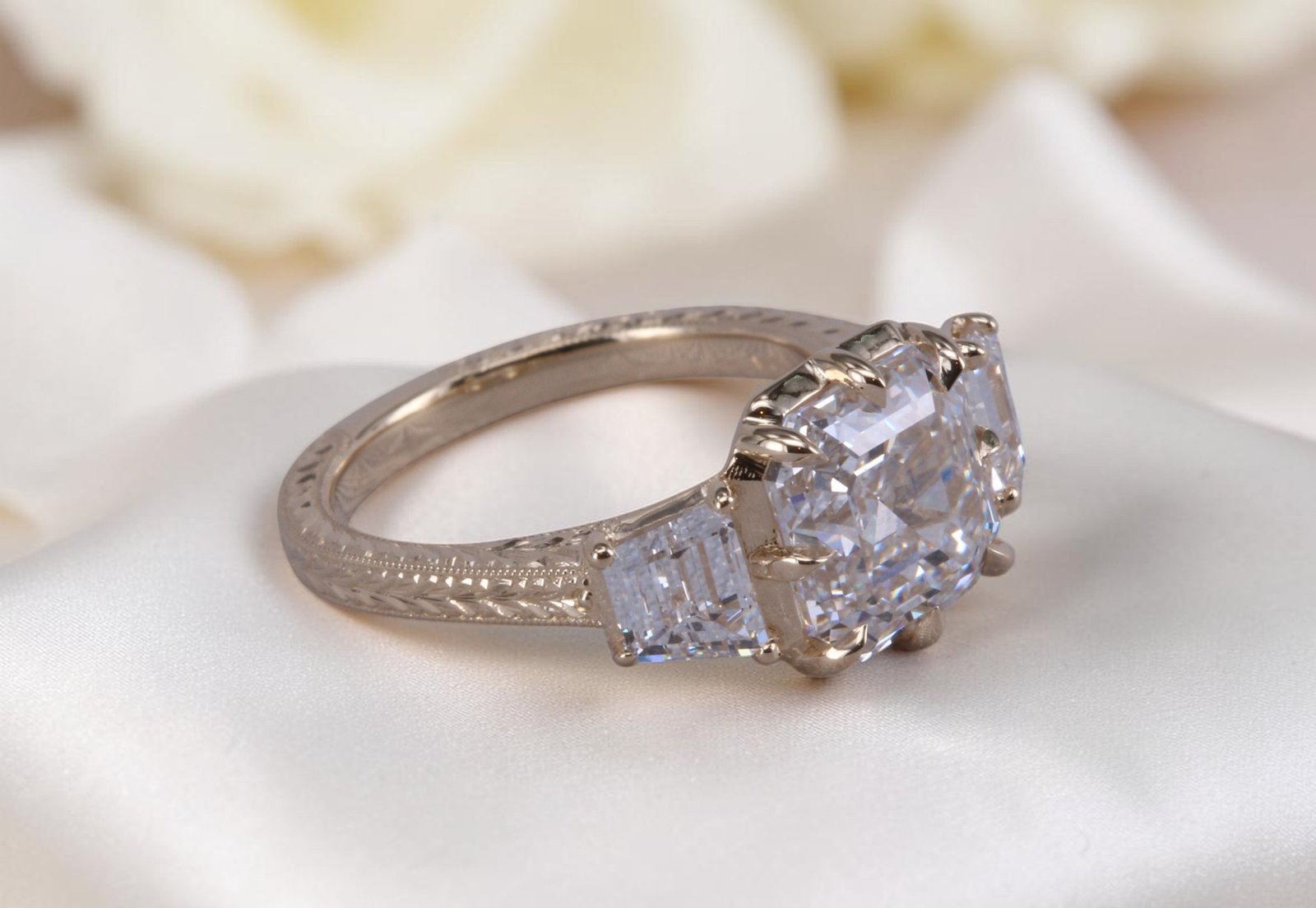
Trevor and Courtney’s ring places a 2.29-carat natural Asscher-cut diamond in cool 14K white gold, extending its lines outward through graduated step-cut side diamonds and channel-set accents.
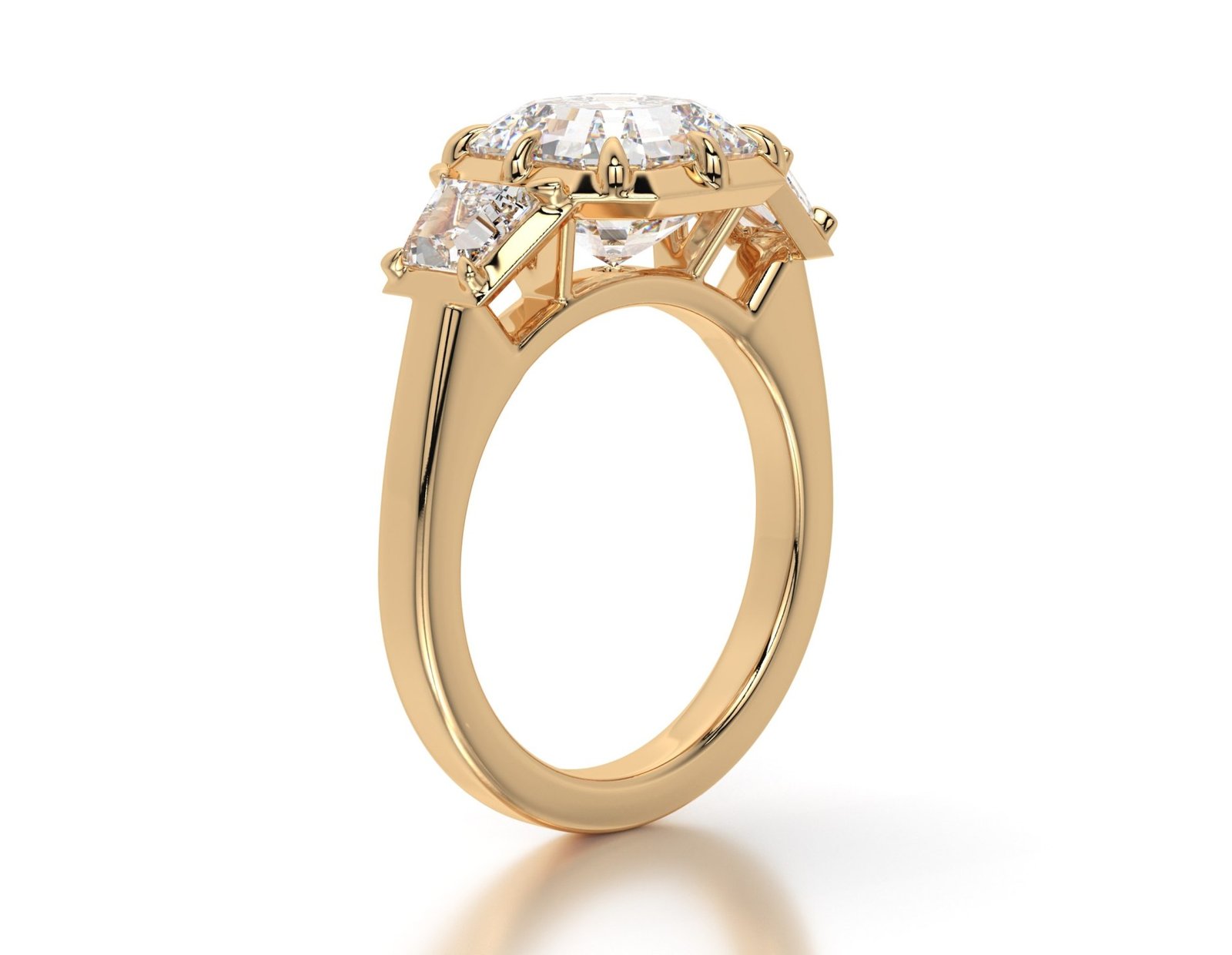
Michael and Tessa’s ring centers a 2.53-carat E-color, VVS2 lab-grown Asscher in warm 14K yellow gold, flanked by custom-cut trapezoid diamonds and finished with engraved detail along the band.
The center stones share the same basic vocabulary — square, symmetrical, deeply stepped — but almost everything surrounding them changes how that vocabulary reads.
What Is an Asscher Cut Diamond?
An Asscher cut is a square step-cut diamond with deeply clipped corners that can make its outline appear almost octagonal. Instead of the triangular and kite-shaped facets used to scatter light through a brilliant cut, its facets run in broad, parallel steps around the diamond. The traditional Asscher developed in the early twentieth century had 58 facets, with a high crown, relatively small table, and deep pavilion shaping the optical character for which the cut became known.
Look directly into a well-proportioned Asscher and the reflections seem to repeat toward the center — a “hall of mirrors” effect, less a field of scattered sparkle than a sequence of bright and dark planes appearing one behind another. GIA describes step cuts such as the Asscher as being valued for this gleaming optical effect rather than the greater brilliance associated with brilliant cuts.
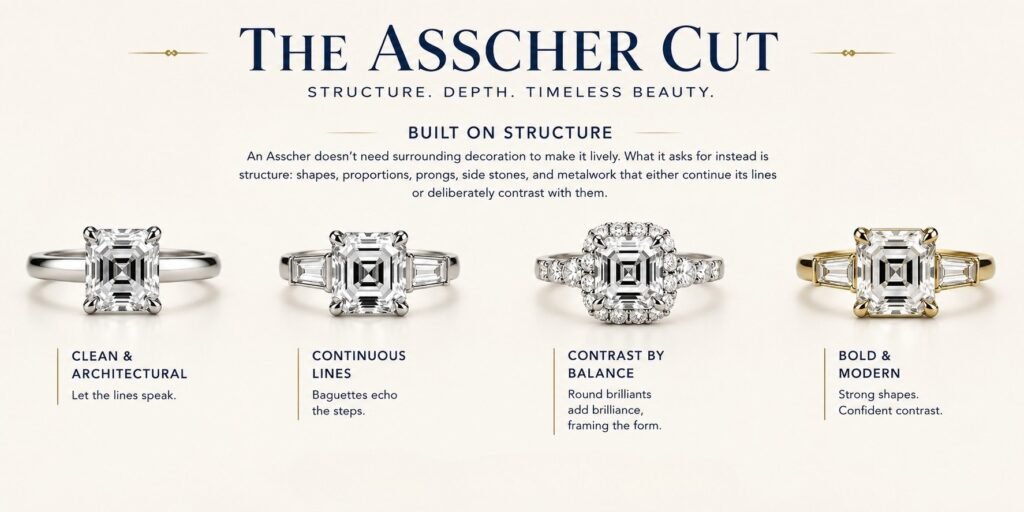
An Asscher doesn’t need surrounding decoration to make it lively. What it asks for instead is structure: shapes, proportions, prongs, side stones, and metalwork that either continue its lines or deliberately contrast with them. Both of Carl’s custom rings work from that same premise, and it’s worth seeing how differently it plays out.
Trevor & Courtney: Extending the Asscher Outward
Trevor and Courtney’s engagement ring ring takes the center diamond’s stepped geometry and continues it across nearly the entire upper surface of the ring.
At the center is the 2.29-carat natural Asscher. Rather than placing round brilliants beside it, Carl used graduated step-cut side diamonds whose long rectangular facets repeat the visual behavior of the center stone, decreasing in scale as they move toward the shoulders. This widens the composition substantially without losing its sense of order — the side diamonds create intermediate stages between the Asscher and the shank, so the eye moves outward through related forms instead of jumping abruptly from one scale to another.
A brilliant-cut side stone would have introduced a different kind of scintillation next to the center — smaller, faster flashes surrounding the slower reflections of the Asscher. Carl instead kept the optical vocabulary consistent, so light moves across the ring in larger planes.
From above, the arrangement almost reads as one composition divided into separate stones. The Asscher stays dominant because of its size and outline, but the side diamonds carry its geometry outward toward the band rather than letting it stop at the prongs.
The result has an unmistakable Art Deco logic — symmetry, repetition, stepped forms, strong rectangular shapes — without feeling like an antique ring copied literally from the 1920s. The surfaces are cleaner, the proportions more substantial, the execution more contemporary.
White Gold and the Discipline of the Design
The ring is made in 14K white gold, and the metal reinforces its precision. The cool color creates very little visual interruption between diamond and setting; it borders and supports the stones without adding another strong color to the composition. That restraint matters because there’s already a lot of visual information across the top of the ring — the large Asscher, multiple step-cut side diamonds, and smaller channel-set diamonds could easily have produced a crowded surface. The limited palette is what lets all of it read as one controlled structure.
The rounded double-style corner prongs introduce one of the few deliberate softenings. The Asscher itself is all straight edges and clipped corners; the paired prongs curve around those corners rather than repeating them rigidly, adding enough sculptural metal to secure and frame the stone without obscuring the outline that makes the cut recognizable.
Channel-Set Diamonds and a Change in Rhythm
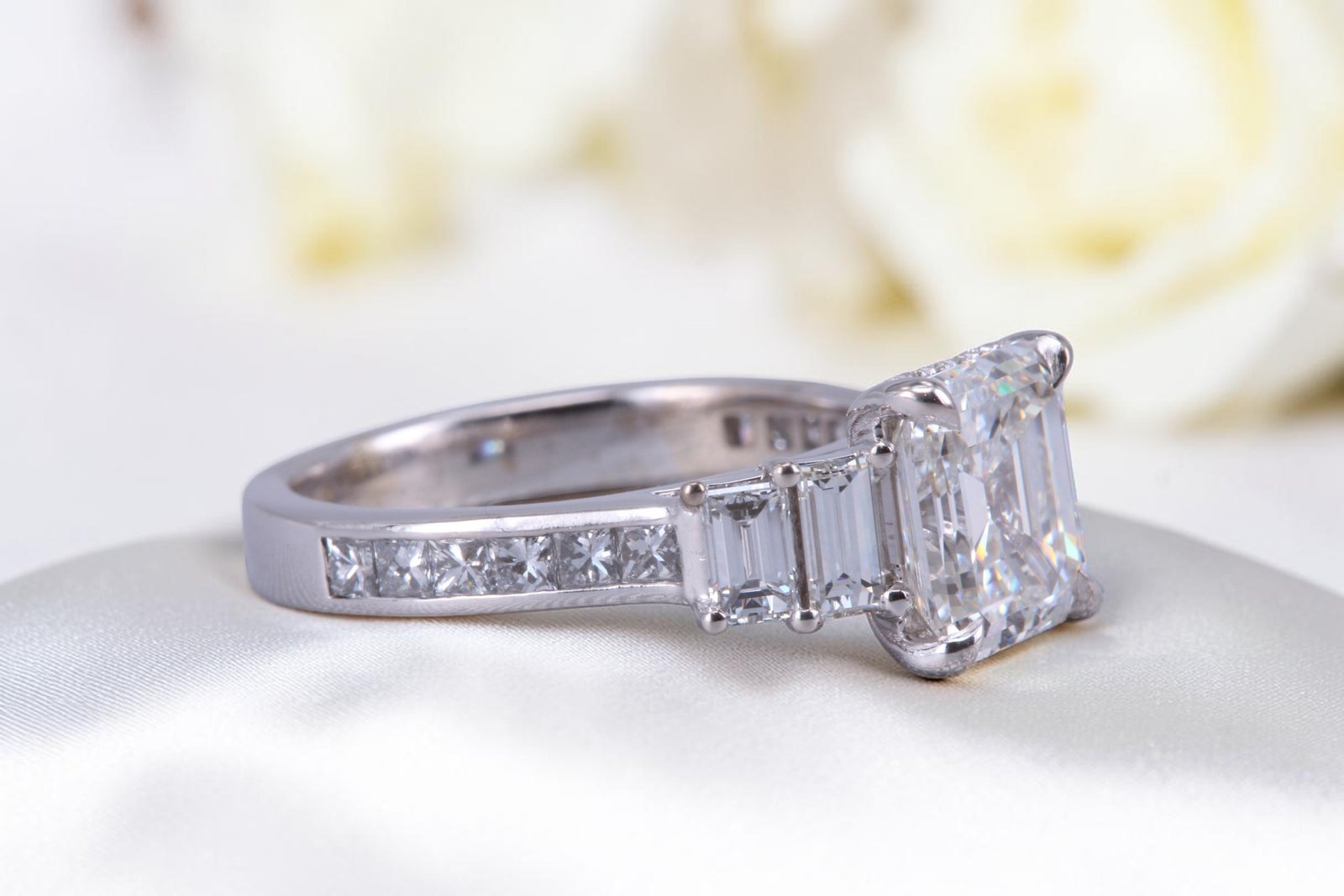
Farther down the shoulders, the faceting changes. A line of smaller channel-set diamonds runs within the white gold band, replacing the large step-cut reflections above with a finer sequence of sparkle below, placed inside straight polished borders to keep it controlled — a narrow illuminated line rather than another competing field of stones.
The ring becomes progressively quieter as it moves away from the center: the broad Asscher dominates, the step-cut side diamonds carry its geometry outward, and the smaller channel-set stones resolve that movement into the shank. It’s a hierarchy that lets the design hold a lot of diamonds without feeling overly ornate.
Architecture Beneath Trevor & Courtney’s Asscher
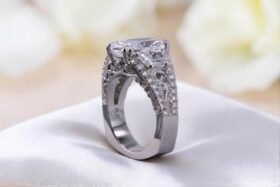
The side view reveals that the design isn’t limited to the top. An elevated open gallery raises the center diamond above the finger while curving supports rise from the band toward the setting, keeping a substantial ring from appearing solid or heavy in profile.
Beneath the Asscher is a detail that can’t be seen from above: a hidden row of small diamonds running under the center stone. That private line of brilliance is a counterpoint to the Asscher itself — above, the diamond’s large step facets produce measured reflections; below, the small diamonds produce a tighter field of sparkle. The two effects occupy different viewing angles, so they never compete.
Michael & Tessa: The Same Cut in Yellow Gold
Michael and Tessa’s ring begins with the same historical diamond shape but changes its atmosphere almost immediately.
The 2.53-carat lab-grown Asscher center diamond is E color and VVS2 clarity, giving its open step facets a particularly clean field to build their repeating reflections.
But instead of continuing that icy quality into white metal, Carl set the diamond in 14K yellow gold. The Asscher stays cool, crisp, and geometric, while the gold around it introduces warmth — the stone appears almost suspended within a golden framework, and a cut so strongly associated with Art Deco takes on a softer, more romantic character.
Where Trevor and Courtney’s ring extends the Asscher through a near-monochromatic composition of white metal and related step cuts, this ring lets contrast do more of the work.
Why the Trapezoids Matter
A custom-cut trapezoid diamond sits on either side of the center stone. Their tapered outlines are especially effective beside an Asscher: the wide inner edge meets the scale of the center diamond, while the narrowing outer edge directs the composition naturally toward the band. The eye moves from square to taper rather than jumping directly from a large center stone into a much narrower shank. The trapezoids also answer the Asscher’s clipped corners — both shapes depend on angled edges, so the transition feels geometrically related even though the stones aren’t identical.
It’s a different solution from Trevor and Courtney’s graduated step cuts. That ring extends the Asscher through repetition; this one extends it through transition. The center remains a strong square, and the trapezoids begin narrowing the composition almost immediately, giving the ring a more conventional three-stone silhouette while preserving the Asscher’s architectural character.
Yellow Gold Against an Icy Diamond
White metal tends to visually merge with colorless diamonds. Yellow gold establishes a boundary around them instead, and in this ring that boundary makes the center stone’s geometry unusually legible — the clipped corners, straight sides, prong placement, and trapezoid transitions all read more clearly against the warm metal.
The gold also shifts the ring’s historical feeling. Asscher cuts are strongly associated with the white-metal jewelry of the Art Deco period, when platinum was especially important in fine diamond work. Carl keeps the cut’s Deco geometry but removes it from the expected cool palette — the result acknowledges the period without trying to recreate it. Vintage influence, here, comes from the relationship among shapes, proportions, and craftsmanship rather than from reproducing every historical convention.
Engraving Against Geometry
The engraved shank pushes the ring even further from strict Art Deco austerity. Fine patterning along the visible gold surfaces introduces texture into a design otherwise built from tightly controlled diamond shapes — a square, stepped center; symmetrically tapered side stones; clear architectural lines in the setting. Then the engraving interrupts that precision with smaller, more ornamental detail.
It works because the two kinds of decoration sit at different scales: the diamonds establish the composition from a distance, while the engraving reveals itself closer to the hand. The stones stay dominant, and the textured gold keeps the ring from feeling severe. That tension — strict stone geometry against warmer, more intricate metalwork — is one of the qualities that sets this ring apart from Trevor and Courtney’s.
The Asscher and Art Deco
It’s easy to call any Asscher engagement ring “Art Deco–inspired” simply because the cut became fashionable during that period, but these two rings show why the connection can mean more than a label. Art Deco design relied heavily on symmetry, repetition, stepped forms, and strong transitions between shapes — and the Asscher naturally contains many of those principles within a single stone. Its clipped square outline establishes symmetry before a jeweler adds anything around it; its facets then repeat that symmetry inward.
Neither ring needs to imitate an antique setting to inherit something from the period; the history is already built into the diamond.
Why the Asscher Returned
The Asscher’s popularity diminished after its Art Deco heyday, as other diamond shapes and brilliant cutting styles came to dominate much of the twentieth century. Renewed interest in vintage jewelry, along with modifications to the historic cut, helped bring the Asscher silhouette back into wider attention around the turn of the millennium. Due to a resurgence around 2002, the Asscher family later introduced a modified, patented version known as the Royal Asscher Cut.
That revival makes sense in custom jewelry today, because the Asscher moves surprisingly easily between periods. Placed in platinum or white gold with strictly geometric side stones, it can lean strongly toward Art Deco. Surrounded by warmer gold or hand engraving, it can feel older and more romantic.
Reduced to a solitaire, it can look almost minimalist. The cut carries history without dictating the rest of the ring — which is exactly what these two designs demonstrate, each starting from the same square, clipped-corner outline and ending up somewhere different: one amplified through repetition and cool white metal, the other softened through trapezoid transitions, warm gold, and engraving.
Joseph Asscher created a diamond whose character depends not on maximum scattered brilliance but on proportion, symmetry, depth, and controlled reflection. More than a century later, that’s still unusually strong material for a custom jeweler to work with — the cut sets the order, and the setting decides what to do with it.
Create an engagement ring built around the diamond.
A custom design begins with more than choosing a center stone. Its proportions, faceting, color, and character can inform everything around it — side stones, prongs, metal, engraving, gallery, and band — until the entire ring feels developed from one idea.
Contact C. Blackburn Jewelers in La Jolla to begin creating a custom engagement ring designed around the diamond and the person who will wear it.
📞 Call 858-251-3006 or text 619-723-8589.