04 Dec Sugarloaf Cut Gems in San Diego Custom Jewelry
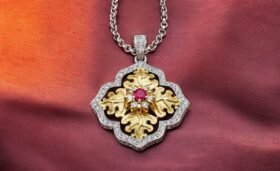
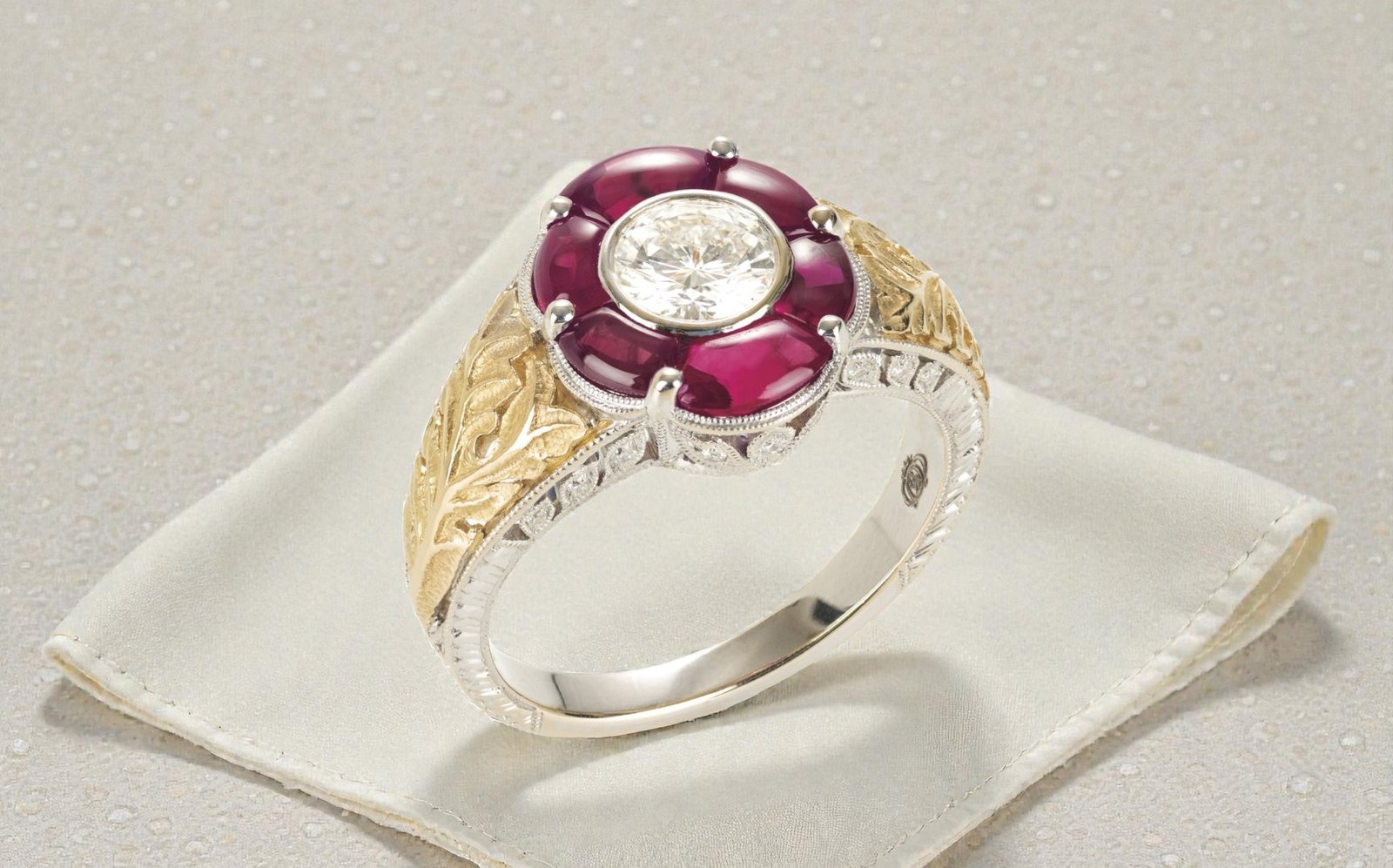
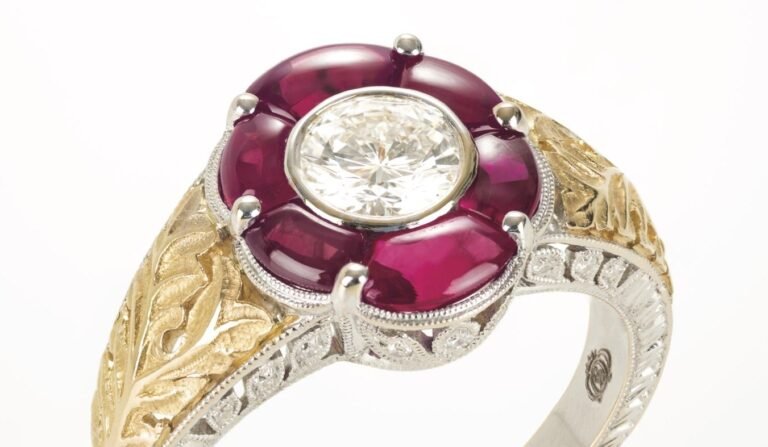
Seen Above: From Carl Blackburn’s Sacred Oak collection, this ring features vivid sugarloaf-cut rubies arranged around a brilliant center diamond, framed by hand-engraved oak-leaf goldwork and delicate platinum filigree. Its sculptural details and rich color contrast evoke heirloom craftsmanship with a deeply symbolic, organic spirit.
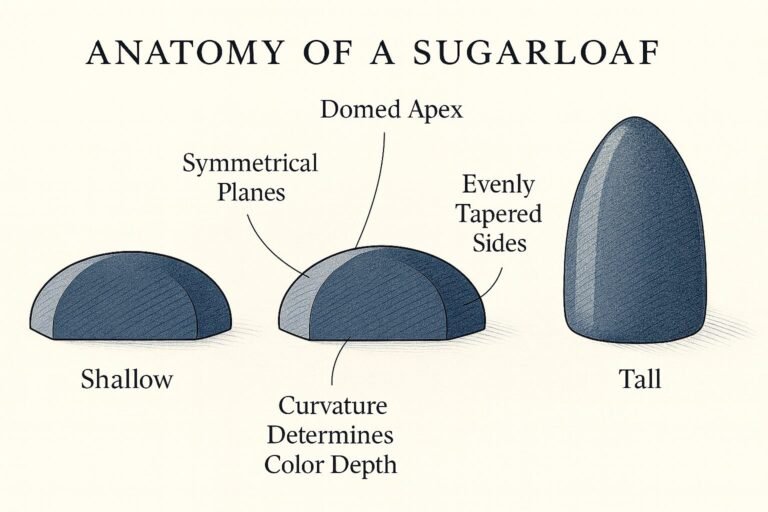
Some gemstones invite light to dance. Sugarloaf-cut stones invite you to look into them. Their domed shape, tapering sides, and uninterrupted surface create an effect closer to sculpture than faceting — a gem that holds color like a reservoir, gathering saturation instead of scattering brilliance.
The sugarloaf is one of the oldest intentionally shaped gem forms still in use today, but its survival into the 21st century is no accident. Only a limited number of lapidaries continue to sculpt stones this way, and only a handful of jewelers have expertise in them. In San Diego, Carl Blackburn and C. Blackburn Jewelers are among those few.
What sets sugarloaf gemstones apart is not simply appearance. It is the discipline and sensitivity required to cut them — and the design insight required to showcase them properly.
The Sugarloaf as Sculpture
Most modern cuts prioritize optical performance: more facets, more angles, more sparkle. The sugarloaf takes the opposite approach. Its value lies in stillness — smooth planes, steady light, the unbroken presentation of color. This creates qualities that no brilliant cut can mimic:
- Volume, because the gem retains more of its rough crystal
- Continuity, because light travels across a single polished surface
- Presence, because the shape stands like a small architectural form
To shape a sugarloaf, a lapidary removes large amounts of material in pursuit of perfect geometry. The apex must rise without distortion; each side must slope evenly; every surface must polish to a liquid finish. Machines can rough out a block, but the final form still depends on handwork.
This is why a true sugarloaf never looks mass-produced. A master’s hand is always visible in the subtle tension between curves and angles.
A Cut with an Ancient Memory
Sugarloaf gems predate faceting by centuries. They evolved from early cabochons, but unlike the soft, rounded domes of antiquity, early sugarloafs introduced structure: a pyramid with softened edges rather than a simple dome.
In ancient India, Persia, and the Mediterranean world, such stones conveyed status not because they were large, but because they were shaped — intentionally transformed from raw crystal into symbolic objects. Centuries later, Renaissance and Mughal jewelers refined the form further, pairing sugarloaf rubies and emeralds with enamel and gold to create pieces that still influence luxury houses today.
Throughout every era, the sugarloaf cut served the same purpose: to make a colored gemstone feel monumental.
Why the Cut Nearly Disappeared
The Industrial Age shifted the jewelry world toward faceting, standardization, and yield efficiency. Cuts that consumed rough, required careful hand-shaping, or demanded slow polishing fell out of commercial favor. The sugarloaf was one of the casualties.
But as collectors and designers began seeking authenticity and individuality again, the cut resurfaced — not as a trend, but as an antidote to mass production. A sugarloaf stone is never generic. It expresses its material honestly: the depth of a sapphire, the vividness of a ruby, the subtle inner glow of tourmaline or spinel.
In an era where color is once again central to fine jewelry, the sugarloaf cut is becoming essential, not nostalgic.
Jewelers Working With the Cut Today
For jewelers, using sugarloaf gemstones is not just a matter of sourcing. It requires:
- Access to cutters who still carve the form by hand
- An understanding of proportion — how tall, how broad, how steep
- Design fluency to support the stone rather than compete with it
This is where Carl Blackburn and C. Blackburn Jewelers distinguish themselves.
Carl’s background in old-world design traditions and his long-standing relationships with specialist lapidaries give him access to sugarloafs of rare quality. But more importantly, he understands what they require. Sugarloafs cannot simply be dropped into settings meant for faceted stones. They need architecture: galleries that lift, metal that frames, lines that echo the gem’s geometry.
His approach treats each sugarloaf as a centerpiece around which the rest of the jewel is composed.
Modern Designs That Celebrate the Sugarloaf Form
At C. Blackburn Jewelers, sugarloaf gems appear in pieces that highlight their sculptural identity. Recent and recurring design applications include:
- Bold platinum or gold rings with tapered shoulders to emphasize height
- Halo designs that use small diamonds or calibré sapphires as crisp contrast to the gem’s smooth polish
- Pendant talismans, where the stone’s luminous body becomes a focal point of color
- Custom creations integrating Art Deco, Mughal, and contemporary influences
- Restorations, where period pieces require true sugarloaf replacements
Whether sapphire, ruby, emerald, spinel, tourmaline, or rarer materials like kyanite or garnet, each stone is chosen for its shape, clarity, and color uniformity — qualities critical to a successful sugarloaf.
The Experience of a Sugarloaf Gem
People who choose sugarloaf gemstones tend to be drawn to qualities beyond brilliance:
- Color you can feel
- Presence you can sense across the room
- Craftsmanship that is visible even without a microscope
- A design language that bridges antiquity and modern aesthetics
A sugarloaf gem behaves less like a “stone that sparkles” and more like a small, polished monument of color. This is why they resonate with collectors who want jewelry that reads as art.
Craftsmanship, Preserved in San Diego
At C. Blackburn Jewelers, the sugarloaf cut is not a novelty; it is a discipline we actively preserve. Our collaborations with specialist cutters, our emphasis on proportion and silhouette, and our commitment to hand-finished settings allow us to design jewelry that honors the cut’s history while making it unmistakably contemporary.
If you’re considering a piece built around a sugarloaf ruby, sapphire, emerald, or another colored gem, we invite you to explore the process with designer Carl Blackburn at our La Jolla studio.
Color, craft, and sculptural beauty converge in this cut — and in the hands of a jeweler who understands it.
📞 Schedule your custom design consultation
Call 858-251-3006 or text 619-723-8589