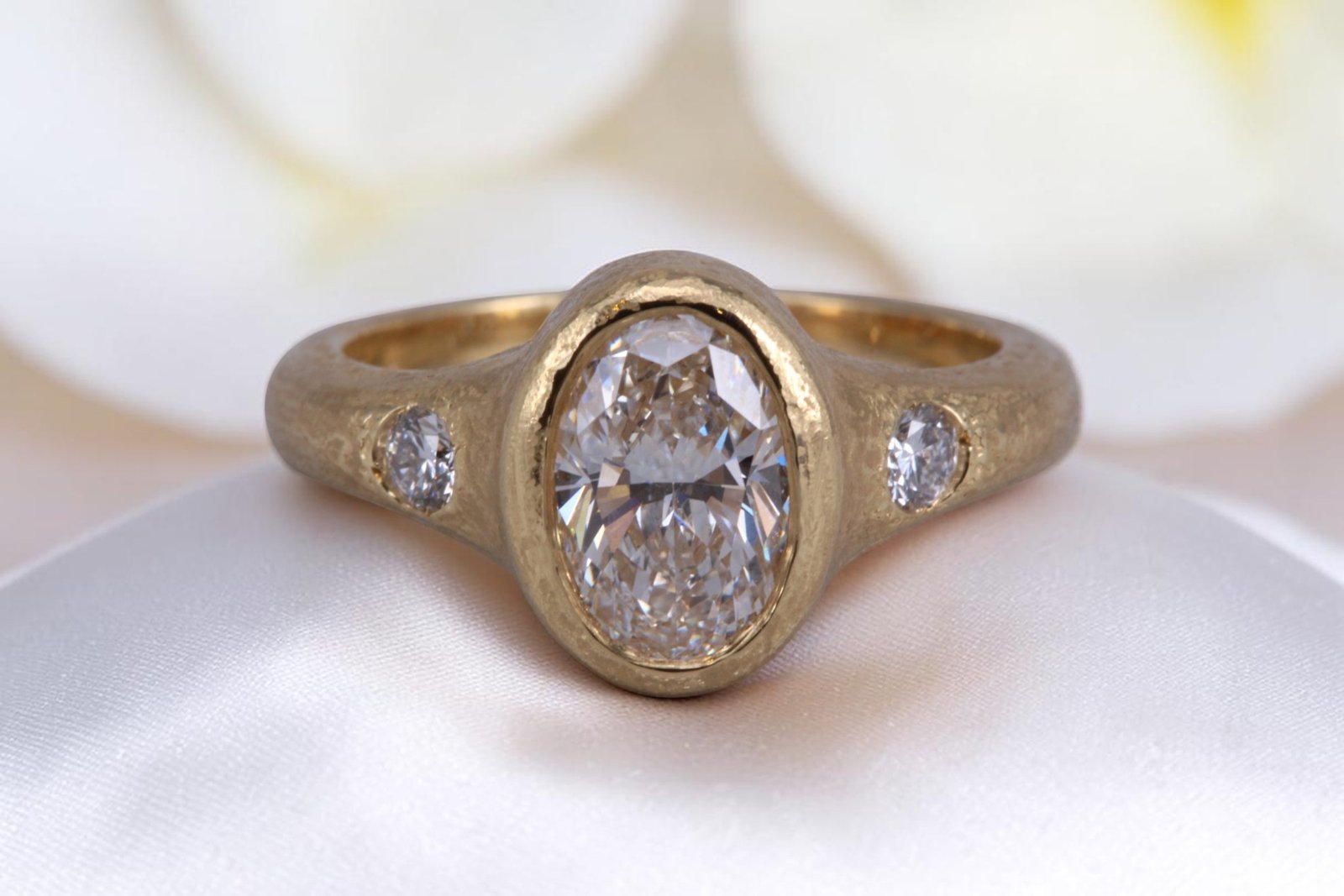
19 Oct Creating an Ancient Inspired Engagement Ring
“If Julius Caesar designed an engagement ring, this is what it would look like.”
For La Jolla custom jeweler Carl Blackburn, the commission began with a firefighter looking for an engagement ring that felt organic, rustic, and ancient.
“So I said to him, what you’re describing is Romanesque,” Blackburn recalled.
The challenge then was making a new ring look as though it had a long history—and setting its diamonds so they seemed to belong naturally within the gold.
Turning an Idea into a Ring
Clients do not always arrive with a particular setting or construction method in mind. Sometimes, as with this commission, they describe a feeling.
“Organic” suggested flowing transitions and a shape that avoided rigid geometry. “Rustic” called for visible texture and an acceptance of irregularity. “Ancient” added the impression of age: softened contours, small pits, and a surface that looked as though it had acquired its character over time.
Blackburn described the direction to his client as “Romanesque”: a substantial gold ring with the presence of an ancient object, brought into the present through its diamonds.
The idea goes beyond surface treatment. The shoulders rise gradually toward the oval center and merge into the surrounding gold. There is no delicate basket holding the diamond above the band; the setting appears to grow out of the ring’s body.
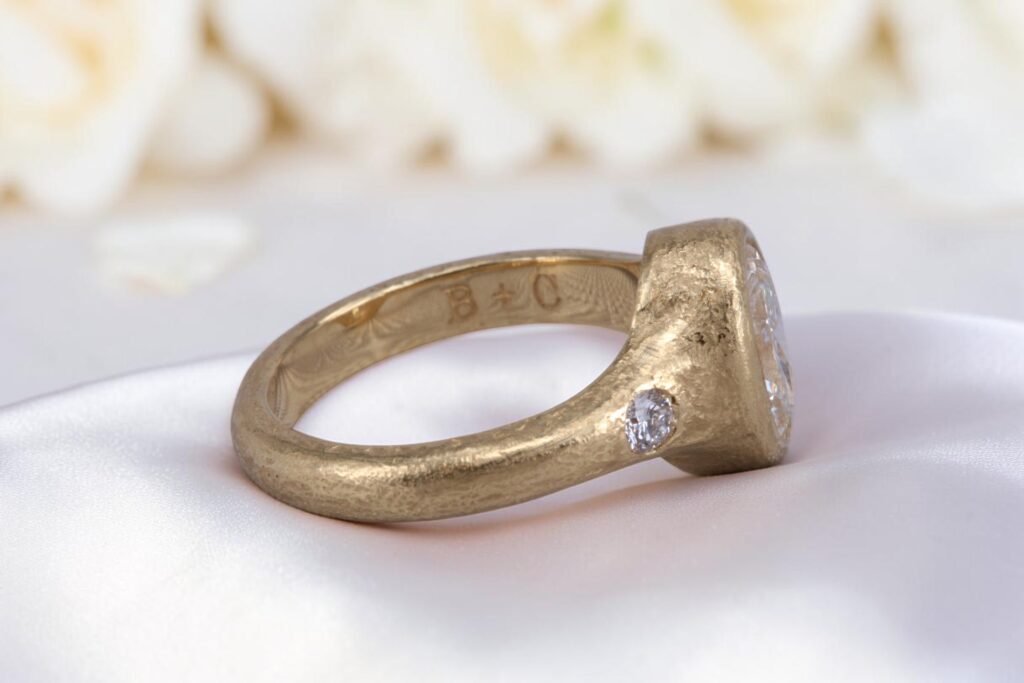
That continuity gives the design its sculptural character. Viewed from the side, the gold flows upward around the center stone, while the band narrows as it curves toward the back of the finger.
Choosing the 1.5-Carat Oval Diamond
The client considered several diamond sizes before settling on a 1.5-carat lab-grown oval.
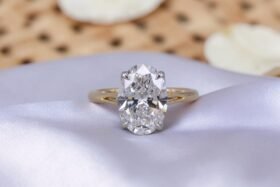
Set lengthwise along the finger, the oval diamond creates a clear focal point, and its curved outline echoes the softened shoulders and rounded edges of the band. The gold border stays a major part of the composition, while the diamond’s faceting brings brightness and movement to the center.
A larger or smaller center would have changed the proportions of the bezel, the amount of visible gold, and the relationship between the oval and its two companions. At 1.5 carats, the diamond has a commanding presence, yet the texture remains immediately visible.
Making the Center Stone Look as Though It Belonged There
One of the client’s most distinctive requests concerned how the diamond should appear within the ring.
“He wanted it to appear like somehow it just belonged there, like in nature,” Blackburn explains.
The stone still needed careful setting, but the client wanted it to seem embedded in the form rather than attached to it.
A bezel supports that idea. A continuous rim of gold surrounds the oval in place of prongs, and its outer contours are softly uneven, tying it visually to the textured shoulders.
The gold immediately around the diamond catches brighter highlights than the surrounding depressions. This outlines the oval without adding a highly polished frame that would feel disconnected from the rest of the ring.
Nestling Two Diamonds into the Shoulders
For the side stones, Blackburn and his client selected two white round diamonds, one on each shoulder.
These were flush set, placing them into the gold without raised prongs or separate projecting settings. Blackburn describes the effect as looking “sort of buried into the gold.”
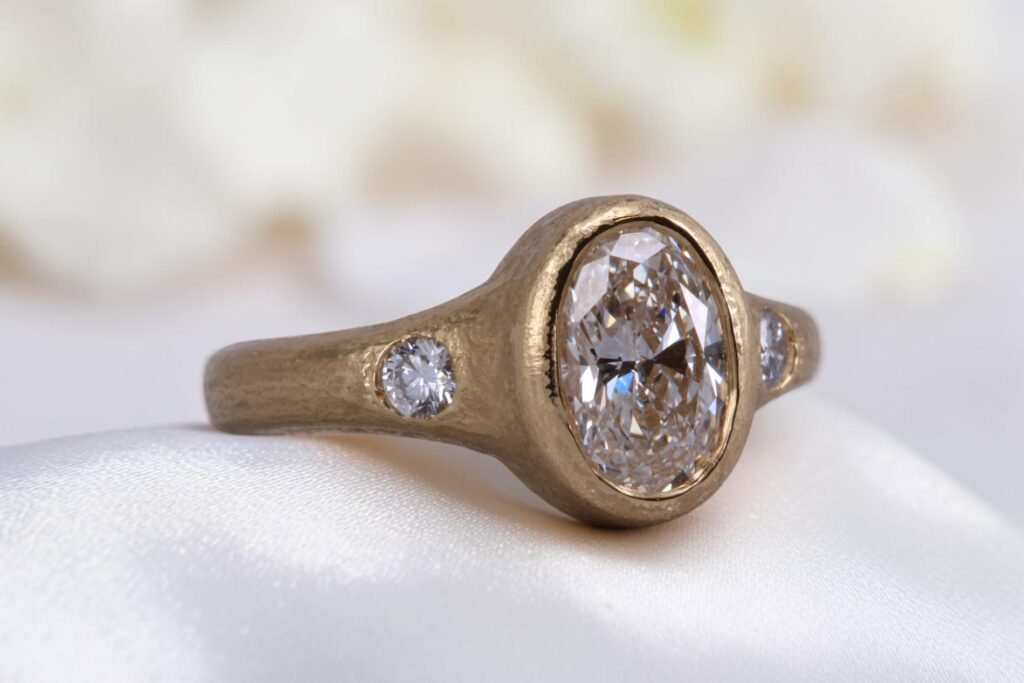
The center stone is enclosed within the yellow gold, and the smaller diamonds emerge from the shoulders as bright points within the textured surface. Their round shapes complement the oval without repeating it. From the front, the three diamonds are balanced; from an angle, the nearer side stone stands out, following the shoulder’s contour closely.
The surrounding gold stays broad, so each small diamond reads as its own feature in the metal rather than part of a line of sparkle.
The Hardest Part: Getting the Surface Right
According to Blackburn, the most challenging part of the project was achieving the gold’s final surface.
“The trickiest part of this particular ring was getting the surface exactly how we wanted it,” he says.
The surface needed to suggest age while still looking like a finished piece of jewelry. Too much roughness would overpower the form. Too much polishing would erase the character the client wanted.
The process began with a very coarse texture, which Blackburn compares to rough orange peel. That gave him pronounced irregularity to work from.
From there, the gold underwent successive rounds of hammering, sanding, burnishing, and polishing. Hammering shaped and marked the metal. Sanding moderated roughness. Burnishing smoothed and compressed selected areas, while polishing adjusted their sheen.
Throughout, Carl had to judge the surface as a whole: how strongly the depressions should remain, where the highlights should fall, and how the finish should move across the shoulders and around the center setting.
Knowing Which Irregularities to Keep
Some uneven and pitted areas were intentionally left in place.
They are particularly visible in the side photograph, where small depressions interrupt the gold near the center setting. Across the band, finer marks create a more subdued texture, with brighter areas along curves and edges.
The variation is essential. A uniform pattern would read as a repeated decorative finish; here the surface changes from one area to the next, giving the eye new details as the ring turns.
The gold keeps a warm luster, with the texture breaking its reflections into smaller, softer passages. Around the oval, brighter edges help define the setting. Along the shoulders, the finish becomes more diffuse, and small recesses stay darker, adding depth.
An Ancient Appearance with a Modern Center
Blackburn’s goal was a one-of-a-kind engagement ring that looked as though it might have been excavated from an ancient Roman site, but with a modern twist.
The crisp facets of the lab-grown oval sit within gold deliberately worked to suggest the passage of centuries, and the two round side diamonds repeat the contrast on a smaller scale.
There is little ornament here. The ring’s identity comes from its proportions, its integrated settings, and its carefully developed surface. Much of the labor went into an appearance that feels unforced: the transitions had to flow, the diamonds had to look at home, and the gold had to retain precisely enough irregularity.
“Rome wasn’t built in a day,” Blackburn says, “and this ring wasn’t either.”
If you have an idea for a custom engagement ring, Carl Blackburn can help you explore the stones, setting, and finish that will bring it to life. Contact C. Blackburn Jewelers in La Jolla to schedule a consultation and discuss your design.
📞 Call 858-251-3006 or text 619-723-8589.