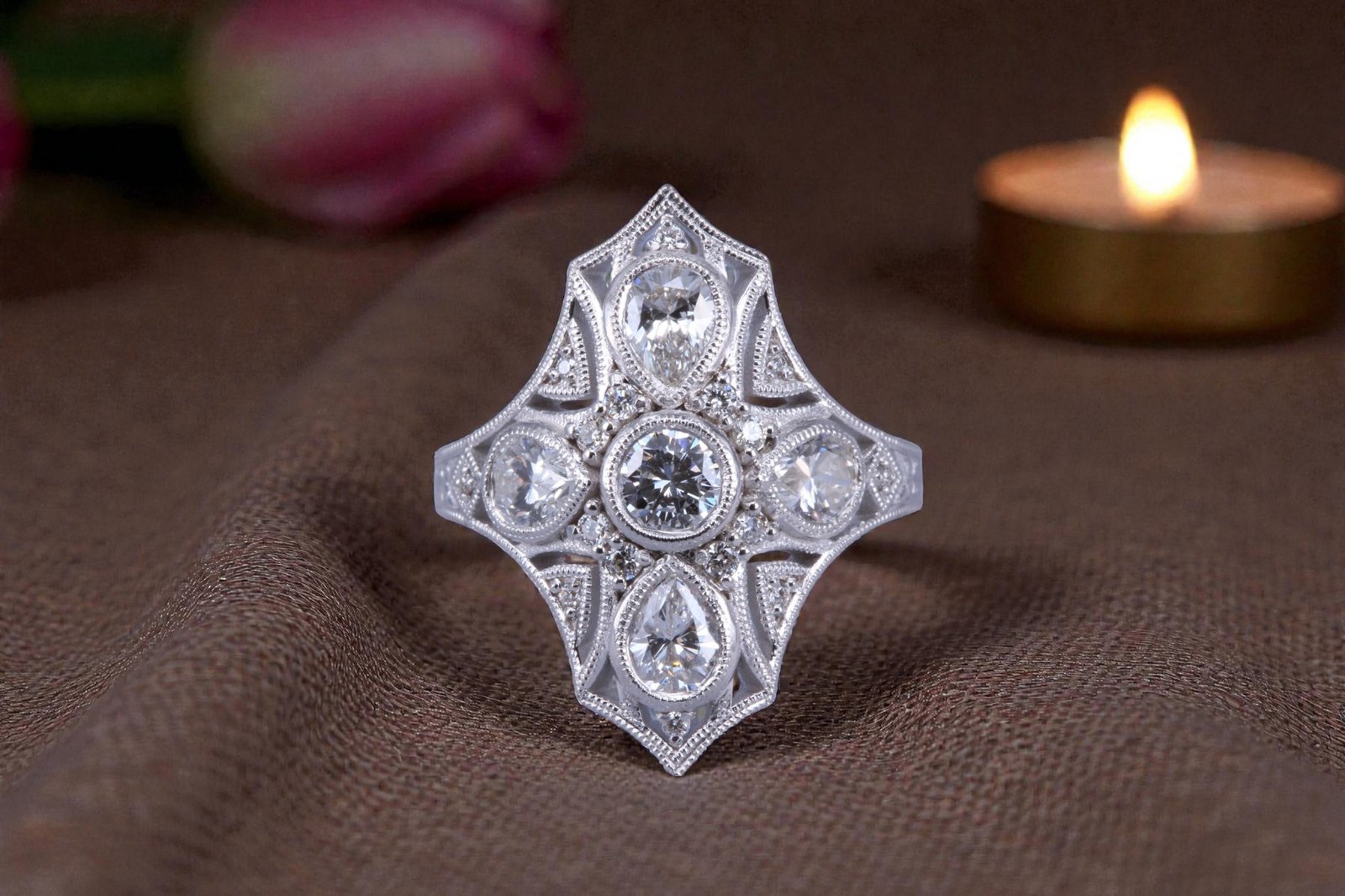
12 Nov “Joan of Arc” Custom Right-Hand Ring by Carl Blackburn
When a client brought her grandmother’s ring to C. Blackburn Jewelers in La Jolla, she had a question for Carl Blackburn: could he remove the diamonds and use them to create an entirely different ring?
The ring held four large pear-shaped diamonds, a round center diamond, and several smaller round diamonds. She wanted to keep those stones and their connection to her grandmother, but the new setting would reflect her own taste.
Carl began by asking what kind of ring she had in mind. She wanted a right-hand ring with Art Deco styling—but something a little edgy.
Finding the Shape in the Client’s Inspiration
The client brought Carl four ring designs to illustrate what she liked. Each had its own details, but he noticed something they shared: all four resembled a shield. That shape suggested a medieval influence, evoking the armored figure of Joan of Arc, and it became the starting point for the new setting.
Designing around existing diamonds requires a different approach from selecting stones for a design already on paper. Their sizes and proportions help determine the layout, the spacing between settings, and the overall dimensions of the ring. In this case, the four pears offered a way to extend the design in four directions around the round center stone.
The smaller diamonds could provide accents between the larger settings. This gave Carl room to develop an intricate design while keeping the five principal stones clearly visible.
Where Art Deco Meets Gothic Revival
Art Deco jewelry of the 1920s and 1930s often used geometric arrangements and strong contrasts of shape. Platinum and diamonds were well suited to its white-on-white designs, with the metal’s strength allowing relatively fine settings that gave the gemstones prominence.
Gothic Revival has earlier roots. Flourishing in the nineteenth century, it drew on medieval architecture and the romantic associations of chivalry. Pointed arches, elaborate window tracery, and other Gothic forms found their way into decorative objects as well as buildings.
Carl’s ring design brings elements of both traditions together. Its balanced diamond arrangement and white platinum setting reflect Art Deco preferences, while the pointed ends and inward-curving sides give it a Gothic character. The open framework around the stones recalls tracery, the patterned stonework that divides Gothic windows.
That combination also evokes Joan of Arc. The ring has something of the presence of a small, ornamental shield, softened by its delicate borders and curved settings. The reference captures its character without tying the design to a particular historical jewel.
Building the Composition Around Five Diamonds
Viewed from above, the right-hand ring has an elongated outline with four projecting points. The round diamond sits at the center, with a pear-shaped diamond above, below, and on either side.
In the finished ring, the tips of the pears point inward. Their rounded ends face the perimeter, contrasting with the sharper points of the platinum outline. The upper and lower pears extend the ring along the finger, while the two lateral stones lead toward the shoulders of the band.
Smaller round diamonds cluster around the central setting and accent selected outer sections. Curved and angular openings separate the larger settings from the surrounding framework, giving each diamond a defined space. These gaps keep the broad face from looking crowded despite the number of stones and decorative details.
What the Design Drawing Reveals
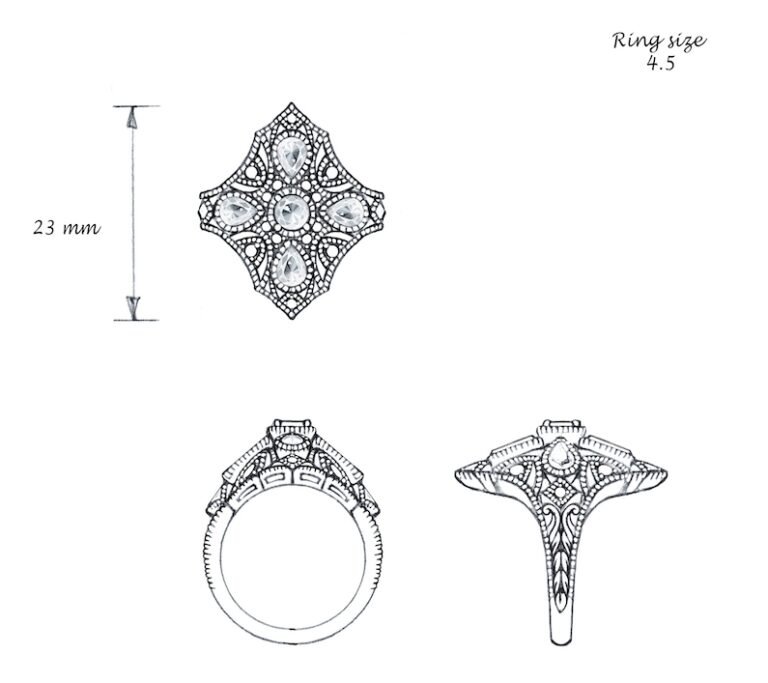
The design drawing shows the ring from three directions and specifies a size of 4.5, with a proposed face length of 23 millimeters. The top view establishes the diamond layout and shield outline; the side views show the height of the settings, their supporting structure, and the transition into the band.
At that length, the face was intended to make a substantial statement on the hand. The drawing shows how its width narrows toward the shank, with ornament continuing down the shoulders. Beneath the diamonds, an open gallery supports the raised settings.
The finished ring shows milgrain borders following the face toward the band, where engraved details continue the decoration. This attention to the shoulders matters on a ring with such a prominent top: from an angle, the band feels like part of the design rather than simply a means of holding it in place.
Why Carl Chose Platinum
Carl chose platinum for three reasons: durability, its naturally white color, and its suitability for the hand engraving and milgrain he wanted to achieve.
Its durability made it an appropriate choice for a new setting intended to hold treasured family diamonds. Platinum is also malleable, a useful quality when forming and working the metal around gemstones.
The natural white color suited both the diamonds and the Art Deco influence. Unlike white gold that has been rhodium plated for a brighter white finish, platinum does not need that coating to maintain its color. For the owner, that removes the need for periodic replating.
Platinum still develops surface marks and a patina with wear. That softer finish can complement antique-inspired ornament, though the metal can be professionally polished when a brighter surface is preferred.
Carl’s third consideration was especially relevant to this design. So much of its detail depends on the treatment of narrow edges and small metal surfaces. He selected platinum with those finishing techniques in mind.
Milgrain, Engraving, and Openwork
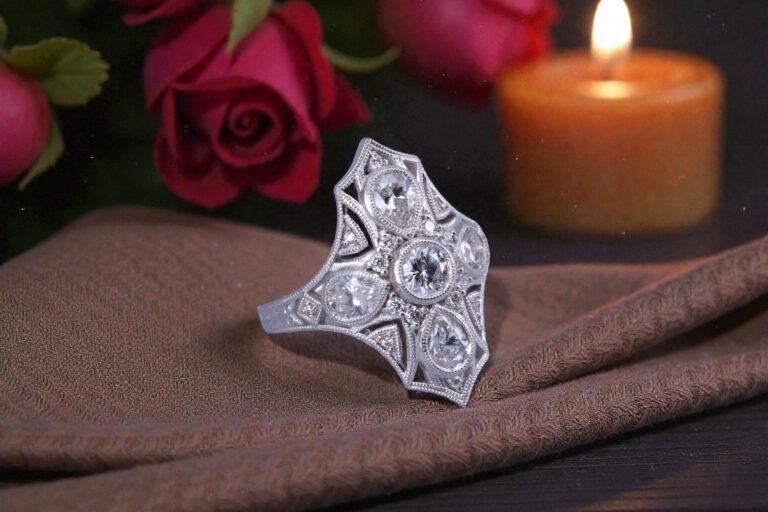
Milgrain is the fine beaded edging visible around the main diamond settings, along the perimeter, and within the smaller decorative sections. Its texture softens the metal borders and distinguishes them from the polished surfaces beside them. Repeating it across the ring gives the different settings a consistent finish.
Hand engraving serves a different purpose. An engraver uses small cutting tools called gravers to cut lines and patterns into the surface of the metal. The engraved ornament on this ring’s shoulders adds detail where the diamond arrangement gives way to the band.
Openwork describes the openings within the metal framework. Here, it gives the “Joan of Arc” ring its lacy appearance and helps define the curves and points of the outer design. It is distinct from traditional filigree, which uses fine metal wires arranged and joined into patterns, although the terms are sometimes used interchangeably when describing delicate jewelry.
These techniques reward a closer look. From a distance, the shield shape and larger diamonds dominate. Up close, the beaded edges, engraved lines, and small diamond accents become easier to appreciate.
An Heirloom Made Personal
The client’s grandmother’s diamonds gave this commission its meaning, while the client’s own preferences determined the new ring’s form. She could keep the stones she valued without continuing to wear the original setting.
The result is a distinctive right-hand ring that makes those diamonds part of her own life and style. Its connection to her grandmother remains in the stones she sees each time she wears it.
To explore a custom right-hand ring or redesign a piece of heirloom jewelry, schedule a consultation with Carl Blackburn at C. Blackburn Jewelers in La Jolla. Bring your existing jewelry and a few inspiration images to discuss what you would like to create.
📞 Call 858-251-3006 or text 619-723-8589.