11 Nov Making a Custom Engagement Ring Worthy of Cleopatra
“If Cleopatra designed an engagement ring, this is what it would look like.”
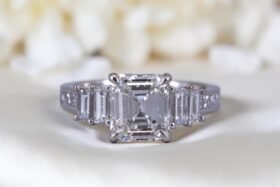
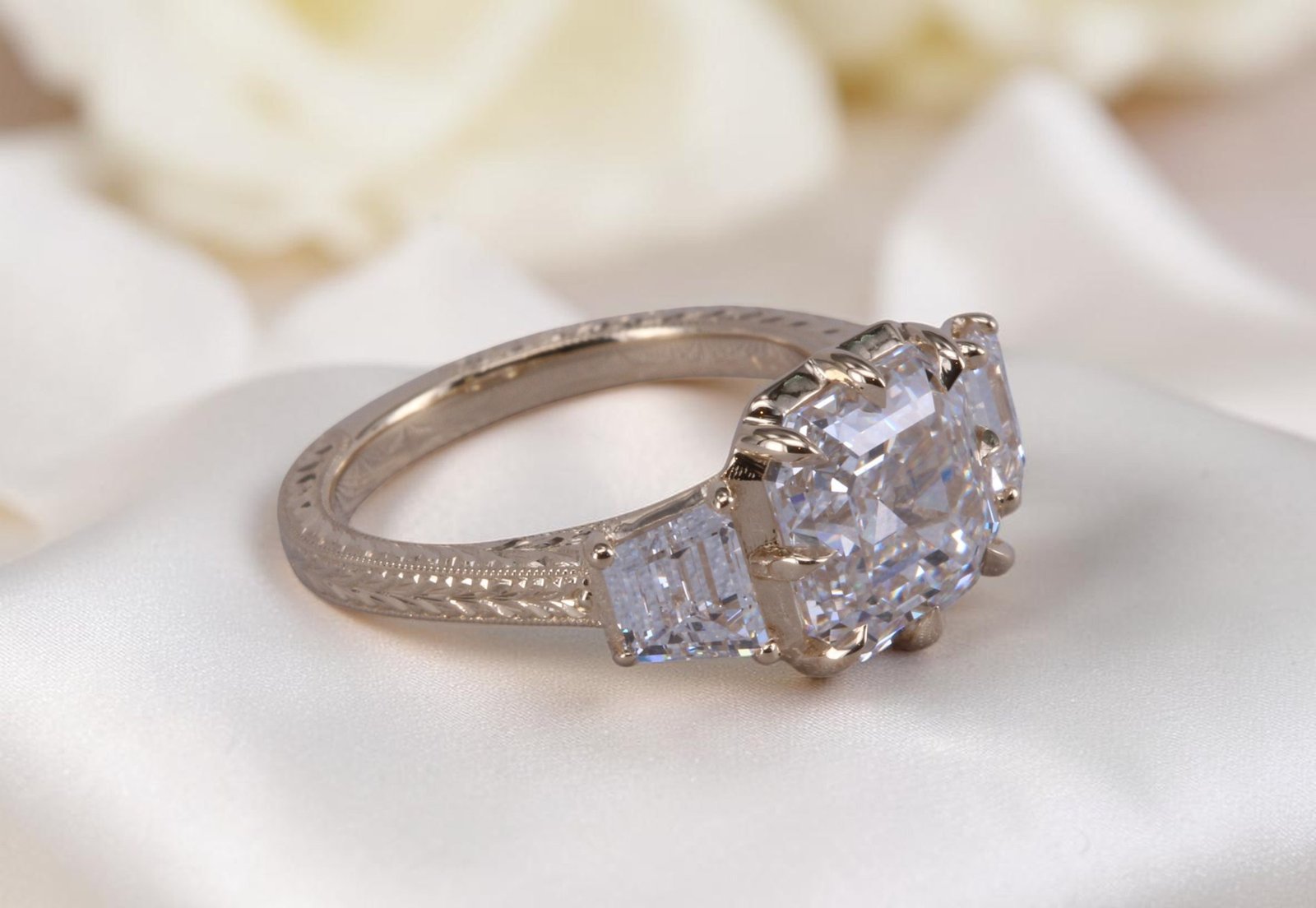
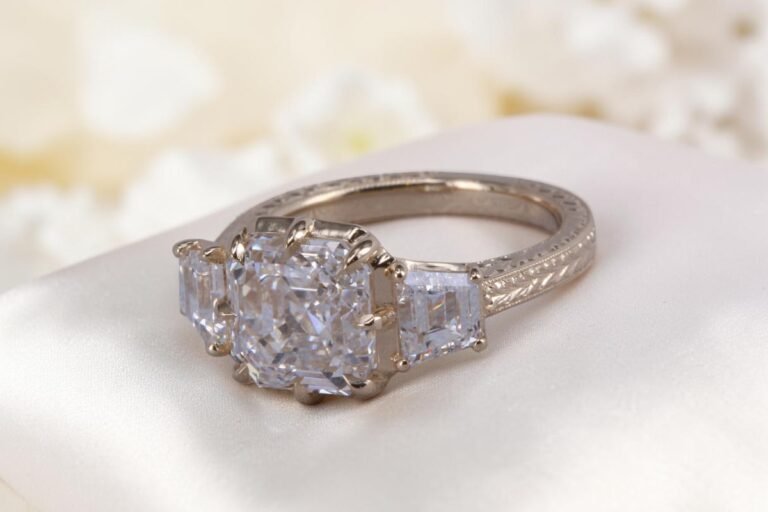
Carl Blackburn’s description suits the bold symmetry of this custom engagement ring, created for a client of C. Blackburn Jewelers in La Jolla. A 2.53-carat Asscher cut lab-grown diamond sits between two trapezoid side stones in a 14-karat yellow gold setting. Double wheat hand engraving and fine milgrain add detail along the band.
The design began with the client’s choice of center diamond. As Carl and his client selected the accompanying stones and setting details, the ring took on an Art Deco character—a connection Carl recognized as the work progressed.
A 2.53-Carat Asscher Cut Center Diamond
An Asscher cut diamond has a roughly square outline with clipped corners and stepped facets that draw the eye inward. In this ring, alternating bright and dark reflections make the diamond appear deep and almost architectural. Its broad facets produce a more measured play of light than the busy sparkle of a round brilliant.
Joseph Asscher developed the original cut in 1902, and it became popular during the Art Deco period. That history makes it a fitting starting point for this design, although the client’s choice came before Carl’s observation about the ring’s emerging style.
The lab-grown center adds a contemporary element. Laboratory-grown diamonds possess essentially the same chemical, physical, and optical properties as natural diamonds, with a different origin. The choice allowed this commission to pair a modern diamond source with a cut associated with early twentieth-century jewelry.
Trapezoid Side Stones Complete the Geometry
Carl and his client chose trapezoids because their shape worked with the Asscher’s geometry. Each sits with its wider edge beside the center diamond and narrows toward the band, creating a gradual transition from the large center stone to the gold shoulders.
The side stones add width without competing with the Asscher. Their linear facets also echo its stepped pattern, so the eye moves easily across all three stones. This is where the design’s proportions become especially important: the trapezoids must be substantial enough to accompany the center while leaving it clearly dominant.
Art Deco and the Egyptian Connection
“We are actually creating an Art Deco style ring,” Carl recalls telling his client as the stone arrangement came together.
Art Deco drew on geometric forms, stylized ornament, and influences ranging from avant-garde European art to the arts of Egypt, Africa, Asia, and the Americas. The 1925 Paris exhibition of decorative and industrial arts became a defining showcase for the movement.
Egyptian imagery gained particular attention after Howard Carter discovered Tutankhamun’s tomb in November 1922. Pyramids, scarabs, hieroglyphics, and other motifs appeared throughout fashion and decorative design. The discovery intensified an existing fascination with Egypt and helped shape Art Deco’s development.
In Carl’s ring, the Egyptian association comes through the angular stones, symmetry, and yellow gold. His Cleopatra comparison is an imaginative way of describing that regal effect. The ring remains a contemporary design, with an Asscher cut developed centuries after Cleopatra’s lifetime.
Yellow Gold and an Open Gallery
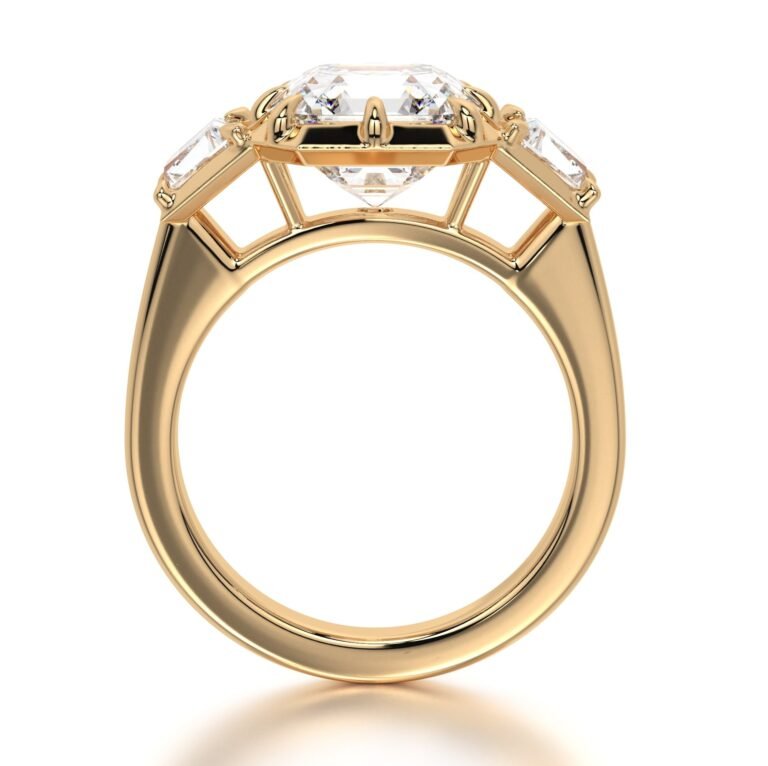
The 14-karat yellow gold setting provides a warm outline around the diamonds and a surface for the engraved decoration. From above, relatively little metal interrupts the three-stone arrangement. From the side, the construction becomes much more apparent.
The profile renderings show an open gallery—the framework beneath the stones—with the center held above two angled side settings. The lower portion of the Asscher remains visible between the supports, and the trapezoids slope toward the shoulders.
Leaving these spaces open keeps the setting from looking heavy beneath the broad stone arrangement. The angled supports repeat the geometry seen from above, giving the side view the same deliberate structure.
Double Wheat Hand Engraving and Fine Milgrain
The renderings show the setting’s smooth surfaces and underlying form. In the finished photographs, hand engraving transforms the band, adding texture where the design otherwise would have been plain gold.
Carl describes the decoration as a double wheat pattern. Repeated angled cuts resemble grains or leaves arranged along a stem, bringing a softer, organic detail to the angular stone layout.
Hand engraving requires a small cutting tool called a graver or burin. The engraver controls its angle, pressure, and depth to cut the pattern into the metal. These cuts catch light differently from the surrounding polished gold, producing small highlights and shadows as the ring moves. Hand engraving is among the traditional decorative techniques used in Carl’s custom designs.
Fine milgrain borders the engraved surfaces. Its tiny metal beads define the edges of the band and give the wheat pattern a neat frame. The combination adds an antique-inspired finish without crowding the diamonds with additional ornament.
A Personal Design with Historical Character
This commission shows how a historical style can emerge from a client’s individual choices. The Asscher and trapezoids led Carl to recognize an Art Deco connection; the gold and engraved finish gave the ring its particular character.
The finished piece has the qualities Carl describes in his video: classic and timeless, yet intriguing and a little edgy. Its broad, angular face makes an immediate impression, while the handwork along the band offers something more intimate for its owner to appreciate.
Create Your Own Custom Engagement Ring
Contact Carl Blackburn at C. Blackburn Jewelers in La Jolla to discuss your custom engagement ring. Bring your ideas about diamond shapes, historical styles, or details you would like to include. request a custom design consultation.
📞 Call 858-251-3006 or text 619-723-8589.