20 Nov The Making of a One-of-a-Kind Engagement Ring
When Graham approached Carl Blackburn about creating an engagement ring for his girlfriend, Julianne, he knew that a traditional diamond solitaire wasn’t going to be right for her. Julianne was an artist with an individual sense of style, and many of the rings she admired looked more like men’s jewelry than conventional engagement rings.
She had given Graham a Pinterest board filled with designs she liked, but there was one condition: she wanted to be completely uninvolved in creating her ring. She trusted Graham to make the decisions and wanted the finished piece to be a surprise.
For Carl, a custom jewelry designer with more than 30 years of experience, the project presented an intriguing challenge. He needed to translate Julianne’s unconventional preferences into a ring that had the bold, substantial appearance she admired while retaining a degree of feminine elegance.
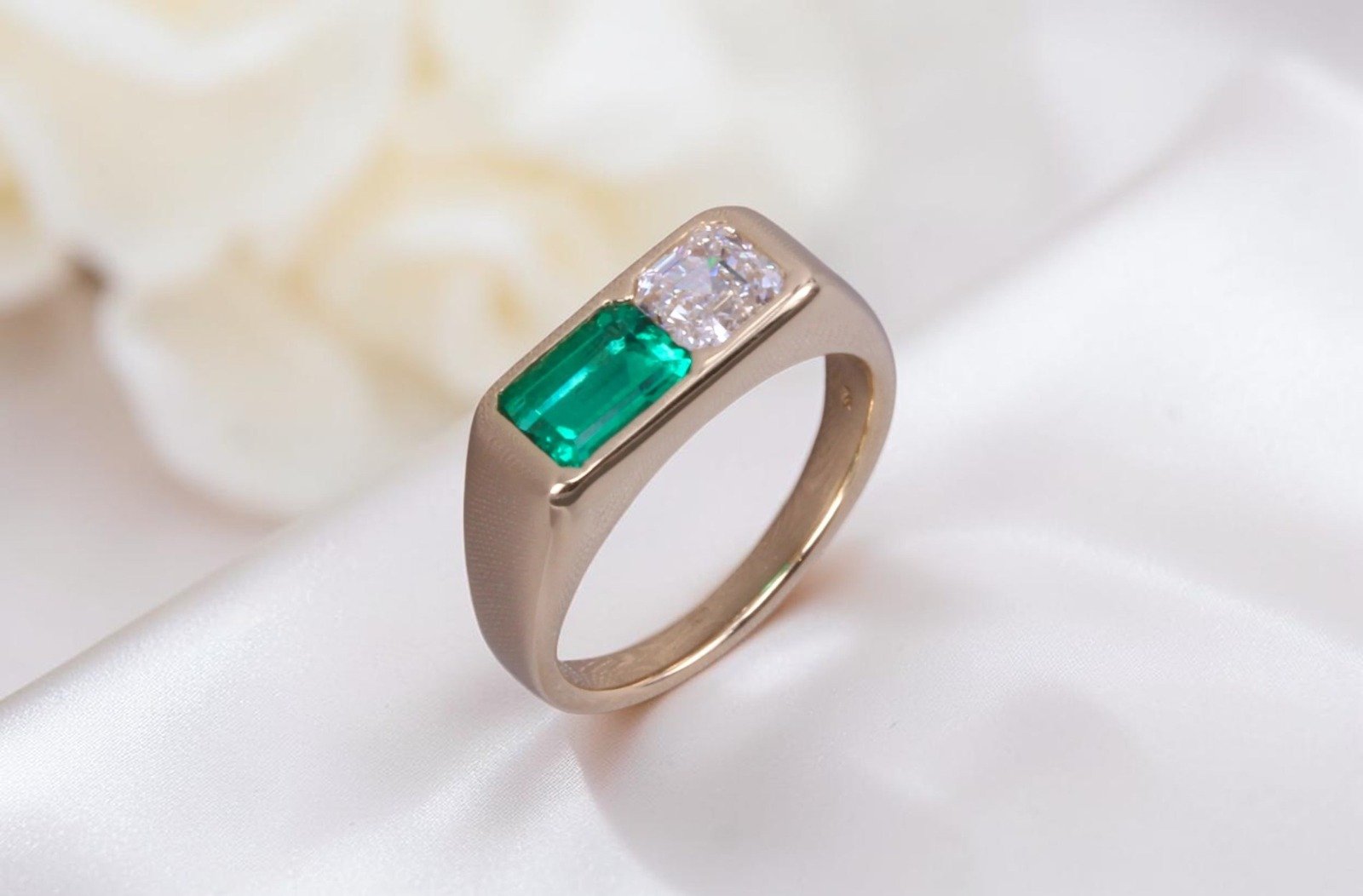
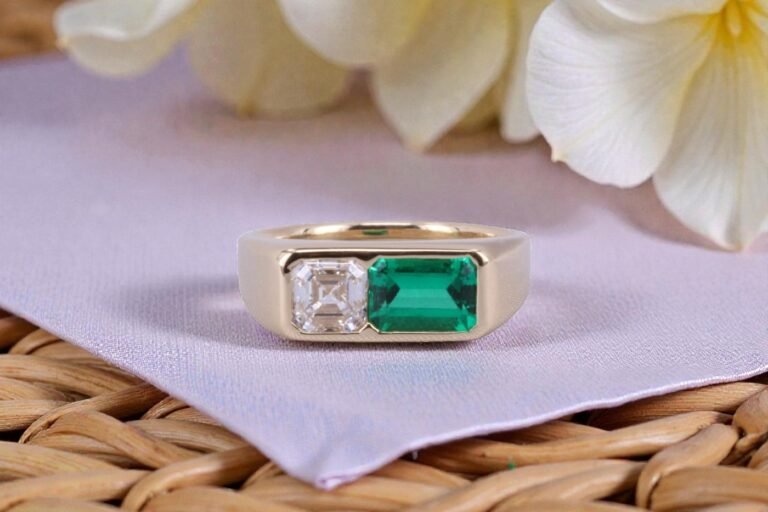
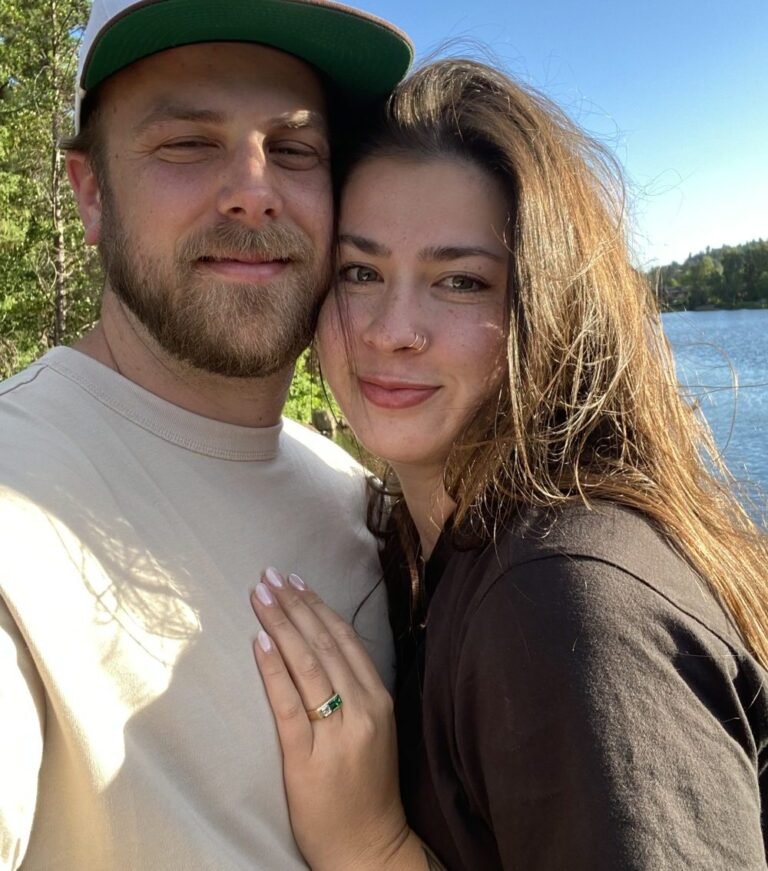
Working closely with Graham, Carl developed a striking two-stone engagement ring featuring a 2.05-carat lab-grown emerald and a 1.01-carat lab-grown Asscher cut diamond, set side by side in a substantial 14K yellow gold band.
The finished design would be unlike anything Carl had previously created.
Finding the Right Direction for Julianne’s Ring
The Pinterest board gave Carl an important starting point, but it wasn’t a ready-made design. The rings Julianne had collected shared certain characteristics: wide bands, strong geometric shapes, and an understated appearance that relied more on form than decoration.
Simply copying one of those designs, however, wouldn’t necessarily produce the right engagement ring.
Carl’s task was to identify what attracted Julianne to those rings and incorporate those qualities into something more personal. The design needed to feel substantial without becoming bulky, contemporary without being ordinary, and feminine without losing the bold character that made the original inspiration appealing.
As Carl and Graham discussed the possibilities, they found a promising direction in the Art Deco period. Its geometric compositions, clean lines, and architectural forms offered a natural connection to the rings on Julianne’s Pinterest board.
Rather than reproducing an antique design, Carl could use those principles to develop a contemporary engagement ring with a distinctive personality.
Selecting an Emerald with Personal Significance
The choice of an emerald came from something more meaningful than its appearance. The green gemstone held personal significance for Julianne, making it an important part of the engagement ring from the beginning.
Carl and Graham decided to pair an emerald with a diamond, combining a gemstone that had special meaning for Julianne with the traditional brilliance associated with engagement rings.
The emerald ultimately selected was a 2.05-carat lab-grown stone with a rectangular emerald cut. Its rich green color would become one of the defining features of the finished ring, but the gemstone’s shape was equally important to Carl’s design.
An emerald cut features long, parallel facets arranged in a stepped pattern. Rather than producing the lively sparkle associated with brilliant-cut gemstones, these facets create broad flashes of light and emphasize the stone’s color.
That geometric appearance suited the Art Deco direction Carl and Graham had chosen. But it also presented a design question: what type of diamond could sit beside such a distinctive gemstone without creating a visual imbalance?
Why Carl Recommended an Asscher Cut Diamond
A conventional round brilliant diamond would have provided plenty of sparkle, but its circular shape and faceting would have introduced a very different visual character beside the rectangular emerald.
Carl suggested an Asscher cut diamond instead.
The Asscher cut is closely related to the emerald cut. Both use step-cut faceting, but while the emerald cut is generally rectangular, the Asscher cut has a square outline with cropped corners.
Carl recognized that this similarity would allow the gemstones to complement each other. Their shapes would be different enough to create interest, but their matching facet patterns would establish a sense of unity.
The diamond selected was a 1.01-carat lab-grown Asscher cut.
Placed alongside the larger emerald, it provides a beautiful contrast in color and shape. The diamond’s white brilliance plays against the emerald’s saturated green, while the square and rectangular outlines reinforce the geometric composition.
Carl also paid attention to the relative sizes of the stones. He wanted them to be prominent without overwhelming the setting. The goal wasn’t simply to place two impressive gemstones together, but to design a complete piece of jewelry in which the stones and gold would be equally important.
Developing the Two-Stone Toi et Moi Design
With the gemstones chosen, Carl could begin bringing the different elements together.
The arrangement he developed is known as a Toi et Moi ring, a French term meaning “you and me.” Traditionally, this style features two principal gemstones positioned together, often representing two people joined in a relationship.
For Graham and Julianne’s ring, the arrangement offered both symbolic meaning and an opportunity to create something unconventional.
Rather than positioning one gemstone as the center stone and using the other as a smaller accent, Carl arranged the emerald and diamond side by side. Both would be prominent features of the ring, each contributing its own color, shape, and character.
The rectangular emerald and square Asscher cut diamond form a compact composition. Their straight edges create a natural visual relationship, while their different proportions prevent the arrangement from feeling overly rigid.
The emerald is the larger of the two gemstones, yet the diamond maintains its own presence because of its contrasting white color and distinctive shape.
Designing the Substantial 14K Yellow Gold Setting
The setting was where Carl could fully express the bold character Julianne admired.
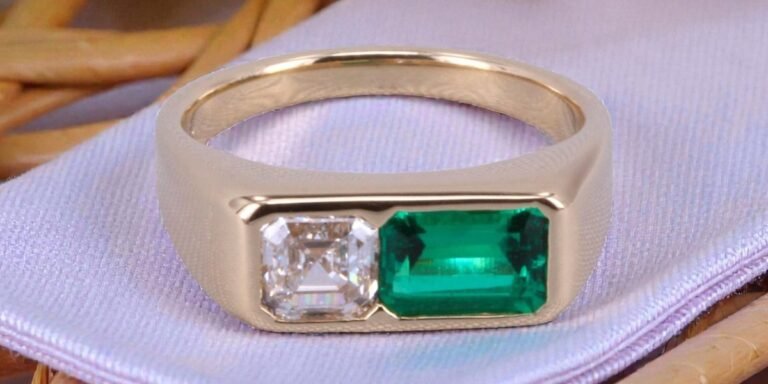
Instead of using a traditional engagement ring band with gemstones raised above the finger, he developed a substantial 14K yellow gold shank with a broad face that accommodates both stones.
The gemstones are positioned closely together in a clean bezel-style setting. Smooth gold surrounds their outer edges, creating a continuous frame that ties them into the band.
This approach gives the ring a distinctly different appearance from a conventional engagement ring. The gemstones appear integrated into the gold rather than sitting above it in prominent prongs.
Carl also avoided unnecessary ornamentation. There are no additional accent diamonds, decorative engravings, or elaborate vintage details competing for attention.
The warm yellow gold works particularly well with the emerald, enhancing the richness of its green color while providing a contrasting backdrop for the white diamond.
The simplicity of the design also meant that the proportions had to be carefully considered. The width of the gold surrounding the gemstones needed to be substantial enough to establish the architectural appearance Julianne liked without making the setting look excessively heavy.
Balancing Bold Proportions with Feminine Elegance
One of Carl’s most important design considerations was the shape of the shank.
Julianne’s inspiration images favored wide, substantial bands. But a ring that maintained the same heavy proportions all the way around the finger could lose some of the elegance Carl wanted to achieve.
His solution was to taper the shank.
The ring is broadest across the front, where the gemstones are set. As the band curves around the finger, it gradually becomes narrower, creating a softer silhouette.
From the front, the ring has the strong architectural character of a contemporary statement piece. Viewed from an angle, the tapered band and gently rounded contours give it a more refined appearance.
The setting also features subtle contouring around the gemstones. The polished gold edges frame the stones without creating the appearance of a separate decorative border.
These details are especially important in a minimalist design. With no elaborate ornamentation to distract the eye, the proportions of the band and the transitions between surfaces become more noticeable.
Carl’s challenge was to achieve a sense of simplicity while carefully balancing these elements.
A Contemporary Interpretation of Art Deco Jewelry
Although the finished ring draws inspiration from Art Deco jewelry, it doesn’t attempt to recreate a historical piece.
There are no elaborate geometric engravings, stepped side panels, or decorative arrangements of small diamonds. Carl instead focused on the broader design principles that made Art Deco jewelry so distinctive.
The emerald and Asscher cut diamond provide the geometric foundation. The broad gold setting gives the ring its architectural character, while the clean surfaces and minimal ornamentation lend it a contemporary appearance.
The result is a ring that feels both modern and timeless, combining the substantial proportions of masculine-inspired jewelry with the refinement of a custom engagement ring.
The Finished Ring—and Julianne’s Reaction
When the ring was completed, Carl felt it was unlike anything he had designed during his more than 30 years as a custom jeweler.
The finished ring had the unconventional character Julianne admired, but it also possessed an elegance that made it unmistakably an engagement ring. Its smooth gold surfaces, contrasting gemstones, and tapered shank gave it a sophisticated appearance that was both bold and refined.
Most importantly, Julianne loved it.
Graham was equally pleased with the experience and the finished design. In a Google review, he praised Carl for helping him develop an unusual concept into a completed engagement ring, particularly appreciating Carl’s willingness to take on a project that fell outside conventional expectations.
For Carl, the project was a memorable example of how rewarding custom jewelry design can be when a client brings an unexpected idea and is willing to explore something different.
Create an Engagement Ring That’s Entirely Your Own
Graham and Julianne’s ring began with a collection of Pinterest images that looked very little like traditional engagement rings. Through his conversations with Graham, Carl identified the qualities that made those designs appealing and found a way to translate them into an original piece of jewelry.
If you’re considering a custom engagement ring, you don’t need to begin with a finished design. A few inspiration photos, a favorite gemstone, or even an unusual idea can be enough to get started.
Contact Carl Blackburn at C. Blackburn Jewelers in La Jolla to discuss your ideas and discover how he can help you create a one-of-a-kind engagement ring that reflects your personal style and story.
📞 Call 858-251-3006 or text 619-723-8589.