17 Nov A Victorian-Inspired Custom Engagement Ring
What would an engagement ring look like if it were designed by a Victorian architect with a taste for fantasy?
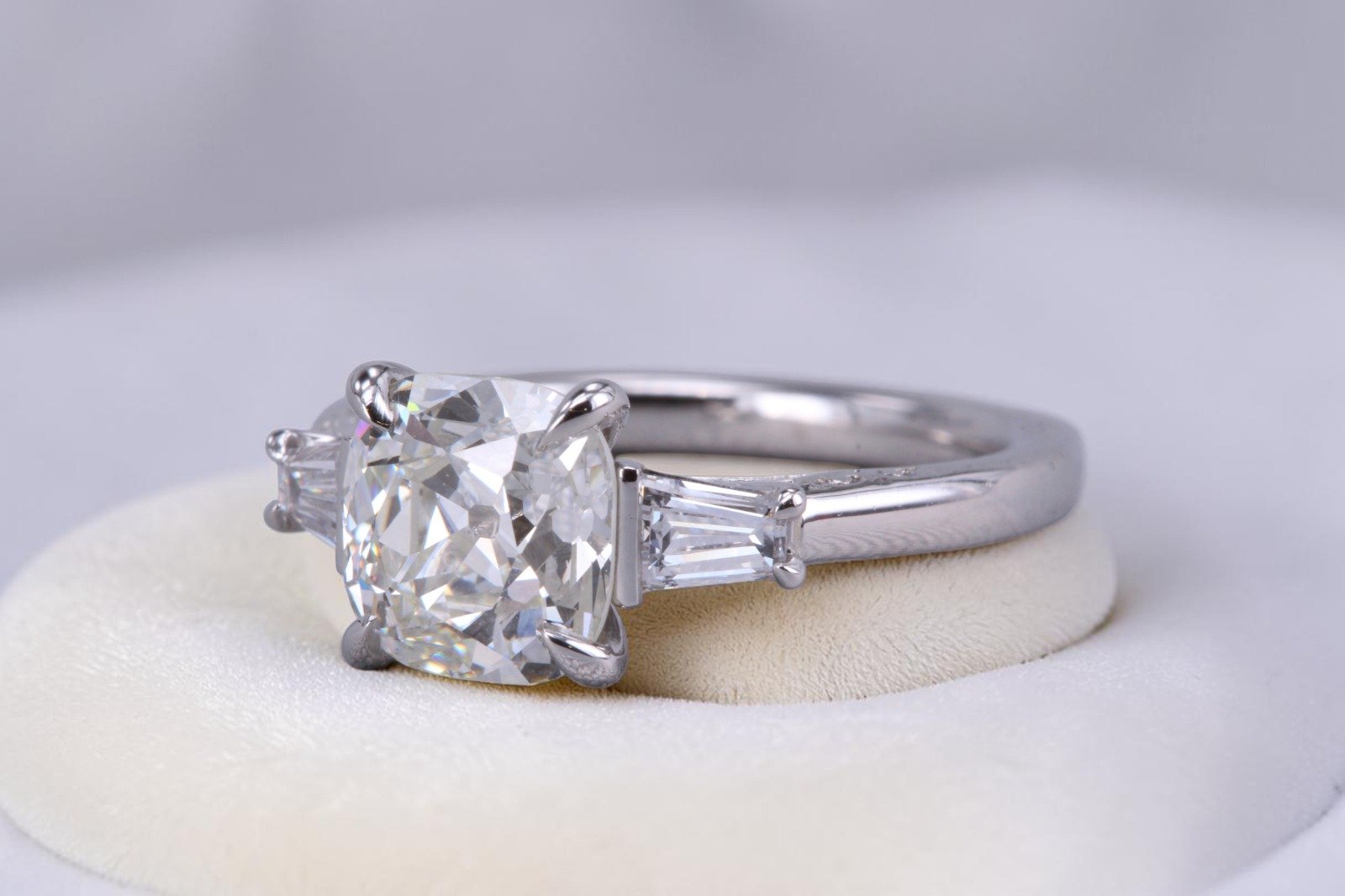
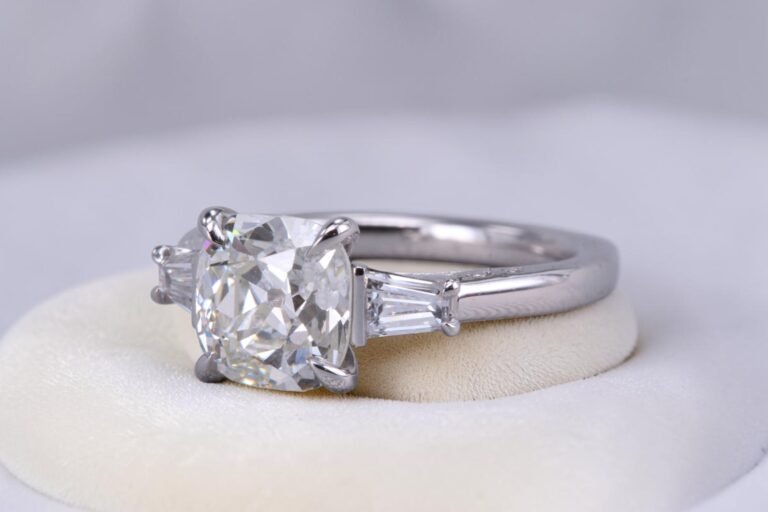
That was the intriguing question behind this custom engagement ring created by Carl Blackburn of C. Blackburn Jewelers in La Jolla, California. Inspired by the elaborate architecture of the late 1800s, the design features a 1.5-carat old mine cushion cut diamond, two tapered baguette diamonds, sculptural eagle-claw prongs, and intricate ornamental metalwork beneath the setting.
At first glance, the ring presents a classic three-stone arrangement. Turn it sideways, however, and an entirely different character emerges. Delicate arches, curling scrollwork, and winglike forms give the setting an architectural quality rarely seen in contemporary engagement rings. The design captures the romance and imagination of the Victorian era without attempting to reproduce a particular antique.
Victorian House Inspiration
When Carl’s client first approached him, he brought several examples of engagement rings that had caught his attention. Although the designs were different, Carl noticed that they shared a common aesthetic. They all seemed to belong to the same architectural family: the elaborately decorated Victorian homes of the late nineteenth century.
The client’s inspiration was particularly close to the more imaginative examples of Victorian architecture, where steeply pitched roofs, decorative arches, elaborate woodwork, and unexpected ornamental details gave buildings an almost storybook appearance. These houses were designed to impress, often incorporating elaborate decorative features simply for their beauty.
During the late 1800s, American Victorian architecture reached extraordinary levels of decorative complexity. The Queen Anne style, particularly popular between 1880 and 1910, embraced asymmetrical forms, towers, turrets, ornamental woodwork, and combinations of architectural features borrowed from earlier traditions.
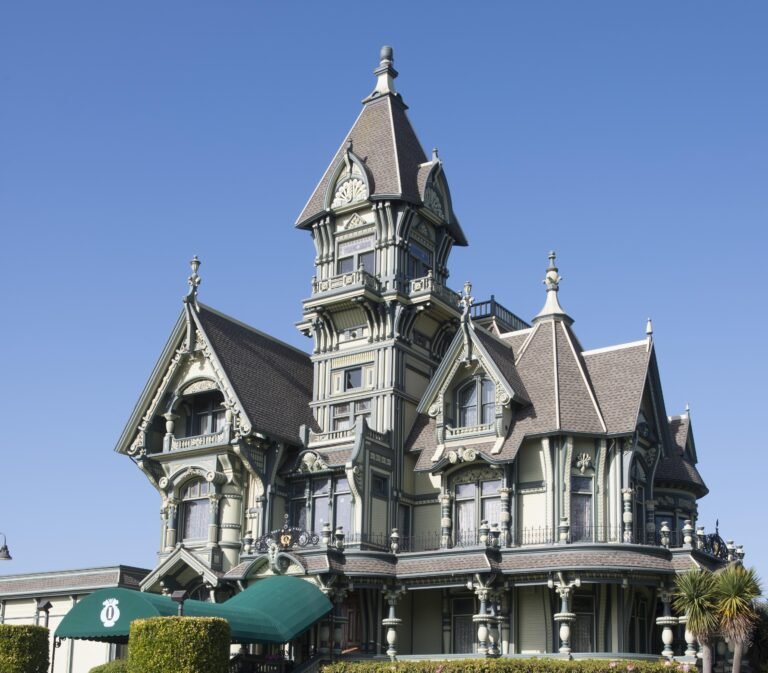
Carl recognized that his client wanted an engagement ring with this same spirit of artistic freedom. The challenge was to translate the architectural character of an elaborate Victorian home into a piece of jewelry small enough to wear comfortably every day.
A Fantastical Style
Carl describes the client’s preferred aesthetic as “fantastical,” an imaginative combination of historical and decorative influences that evokes the romantic atmosphere of Victorian architecture.
Rather than following a single established architectural movement, this aesthetic draws from Gothic Revival, Victorian ornamentation, Art Nouveau, and even the geometric sensibilities that would later characterize Art Deco. Although these movements emerged during different periods, they provide an extensive visual vocabulary for designers interested in creating jewelry with an old-world character.
Gothic architecture contributes pointed arches, dramatic silhouettes, and intricate tracery. Art Nouveau introduces flowing curves and shapes inspired by the natural world, while Art Deco offers a contrasting appreciation for symmetry and geometry.
For this engagement ring, Carl and his client were particularly interested in imaginative decorative forms inspired by dragon wings, butterfly wings, and eagle claws. These influences would eventually find their way into the metalwork beneath the diamonds, where the ring’s more unusual features are concentrated.
The goal was never to copy an existing Victorian ring. Instead, Carl wanted to create something that captured the artistic imagination of the period while reflecting his client’s individual tastes.
A Diamond with Age
Finding the right center diamond was essential to the design. A modern brilliant-cut diamond, with its precise symmetry and highly refined proportions, would have seemed out of place in a ring intended to evoke the late Victorian era.
Carl and his client chose a 1.5-carat old mine cushion cut diamond, a cutting style closely associated with jewelry from the eighteenth and nineteenth centuries. Unlike modern diamonds, which are typically cut using standardized proportions, old mine cut diamonds were historically shaped by hand, often following the natural form of the rough stone.
Their distinctive appearance comes from a combination of softly squared outlines, rounded corners, higher crowns, deeper pavilions, and larger facets. Older examples frequently display subtle irregularities in their shapes and facet arrangements, characteristics that many antique jewelry enthusiasts find especially appealing.
For this project, those irregularities were precisely what the client wanted. He was looking for a diamond that appeared to have been cut approximately 150 years ago, before modern cutting technology made precise symmetry the industry standard.
He also requested a slight yellow tint, preferring the warmth of a diamond that looked as though it had been passed down through generations. Rather than seeking the icy whiteness often associated with contemporary engagement rings, the client wanted a stone with a softer, more historical character.
The diamond’s subtle warmth and antique-inspired faceting helped establish the visual direction for the entire ring.
Old Mine Cut Beauty
One reason old mine cut diamonds remain so popular in antique-inspired jewelry is their distinctive interaction with light.
Modern brilliant-cut diamonds are generally designed to maximize brilliance through precisely calculated facet arrangements. Old mine cuts, developed long before contemporary diamond-cutting technology, produce a somewhat different effect. Their larger facets tend to create broader flashes of light rather than the smaller, more rapid flashes often associated with modern brilliant cuts.
Historically, these diamonds were admired during an era when homes were illuminated by candles and gas lamps. Their deep proportions and distinctive faceting could produce beautiful flashes of light under these warmer lighting conditions.
The old mine cut as a predecessor to modern brilliant cuts, with characteristic features that include a relatively small table, high crown, deep pavilion, and prominent culet.
For Carl’s client, choosing this diamond was about more than its appearance. The cutting style established a historical connection between the center stone and the Victorian architectural influences that would shape its setting. A modern diamond might have been more symmetrical, but it would not have conveyed the same sense of age and character.
A Three-Stone Setting
Although the design incorporates unusual decorative details, its basic structure follows the familiar arrangement of a three-stone engagement ring.
The 1.5-carat old mine cushion cut diamond occupies the center, accompanied by a tapered baguette diamond on either side. The contrast between these diamond shapes is particularly effective. The cushion cut has softly rounded corners and an antique-inspired facet pattern, while the baguettes have long, straight edges and a distinctly geometric appearance.
Together, they create a balance between romantic curves and clean architectural lines. The tapered baguettes also serve an important compositional purpose, directing attention toward the center diamond while providing a graceful transition to the polished band.
Viewed from above, the arrangement is relatively restrained. The center stone commands attention, while the two side diamonds provide additional brilliance without overwhelming the design.
Carl reserved the most elaborate decorative elements for the gallery and shoulders beneath the stones. This allows the engagement ring to retain the familiar elegance of a traditional three-stone setting while revealing a far more imaginative personality from other angles.
Architecture Beneath the Diamonds
The side profile reveals the most remarkable aspect of this custom engagement ring: the intricate metalwork beneath the diamonds.
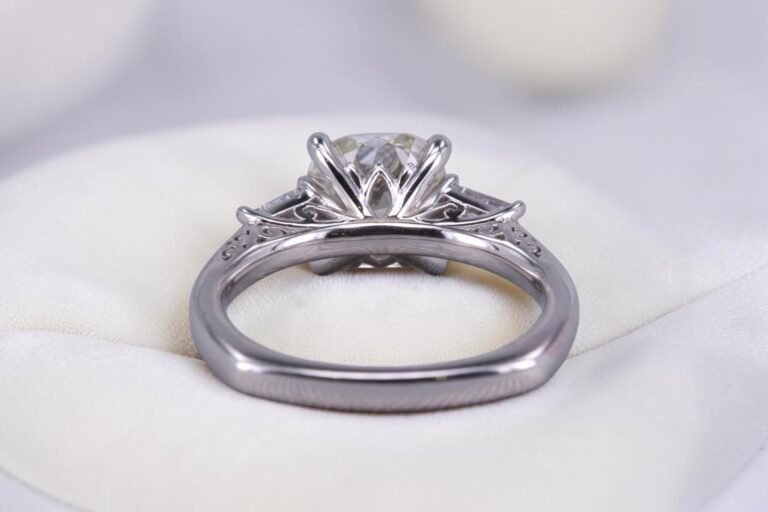
Directly below the center stone, a series of rising, pointed forms create a gallery reminiscent of Gothic arches. The metalwork curves upward toward the diamond, forming shapes that resemble the structural supports of medieval architecture or the pointed petals of a flower.
On either side, graceful openwork extends beneath the tapered baguettes, connecting the center setting to the shoulders of the ring. These ornamental elements suggest wings spreading outward from the central diamond.
Depending on the viewer’s imagination, the shapes might recall dragon wings, butterfly wings, or the elaborate decorative ironwork found in historic Victorian buildings. The open spaces between the metal components keep the design from appearing overly heavy, allowing the individual forms to remain clearly defined.
The ring also features delicate scrollwork along the upper sides of the shank. These curling details resemble the decorative brackets, carved woodwork, and wrought-iron flourishes that were popular in nineteenth-century architecture.
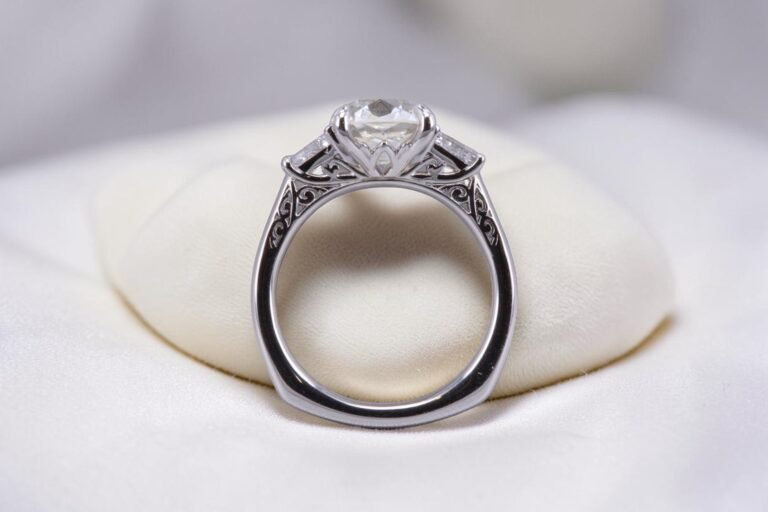
When viewed from the side, the setting takes on the appearance of a miniature architectural structure. The ornamental supports rise toward the center diamond, giving the design a sense of height and movement.
What makes this arrangement particularly effective is that the ornamentation does not compete with the gemstones. From above, the three diamonds remain the focal point. The more elaborate details are revealed only when the ring is examined from the side or beneath, rewarding anyone who takes the time to look more closely.
Eagle-Claw Prongs
One of the final design decisions involved the prongs securing the three diamonds.
Rather than using conventional rounded prongs, Carl incorporated small eagle-claw prongs that complement the ring’s Gothic-inspired character. These prongs curve over the stones with a sculptural, talon-like appearance, introducing another subtle reference to the animal imagery associated with historical decorative arts.
Birds, dragons, and other creatures appeared frequently in Gothic and Victorian ornamentation, from carved architectural details to elaborate metalwork. The eagle-claw prongs bring a similar influence to this engagement ring on a much smaller scale.
The choice also illustrates how a functional jewelry component can contribute to the artistic character of a piece. Prongs must securely hold gemstones in place, but their shape can significantly influence the appearance of a setting.
Here, the claws add a slightly dramatic touch without drawing unnecessary attention away from the diamonds. Their curved profiles complement the surrounding metalwork, making them feel like a natural extension of the overall design rather than a separate decorative addition.
The Practical Euro Shank
Another important feature is the ring’s European shank, commonly known as a Euro shank.
Unlike a traditional engagement ring band, which has a consistently rounded profile, a Euro shank incorporates a flatter, somewhat squared shape at the bottom. This subtle modification provides both an aesthetic and practical benefit.
From a design perspective, the squared lower portion introduces a geometric element that complements the architectural character of the setting. It also creates an interesting contrast with the flowing curves and decorative scrollwork surrounding the diamonds.
More importantly, the Euro shank can help reduce the tendency of an engagement ring to rotate on the finger. Rings with prominent center stones sometimes spin because much of their weight is concentrated at the top. The flatter bottom of a Euro shank can provide greater resistance to this movement, helping the setting remain upright during everyday activities.
For this particular ring, the Euro shank was an especially appropriate choice. It reinforced the geometric qualities of the design while addressing a practical consideration associated with elevated three-stone settings.
The result is a polished band that looks traditional from most angles but reveals a subtly squared profile when viewed from beneath.
Ornament and Everyday Wear
One of the challenges of creating an engagement ring inspired by elaborate historical architecture is deciding how much ornamentation to include.
Victorian buildings could accommodate enormous amounts of decorative detail. Towers, gables, carved brackets, stained-glass windows, and ornamental ironwork might all appear on a single house. Translating that richness into jewelry requires a more selective approach.
Too many decorative elements can overwhelm the gemstones, make a design appear unnecessarily complicated, or interfere with comfortable everyday wear.
Carl addressed this by concentrating the most intricate details beneath the diamonds, where they could contribute to the ring’s personality without dominating its appearance.
The upper surfaces remain relatively simple, allowing the center diamond and tapered baguettes to establish a balanced, recognizable three-stone arrangement. Beneath them, the Gothic-inspired arches, winglike forms, and ornamental scrollwork introduce the character that makes the design distinctive.
The open gallery also helps prevent the elevated setting from appearing excessively heavy, while the Euro shank provides additional resistance to unwanted rotation.
The finished ring demonstrates how elaborate historical influences can be incorporated into contemporary jewelry without sacrificing the elegance and practicality expected of an engagement ring.
An Heirloom with Character
One of the great advantages of custom engagement ring design is the ability to create something that feels connected to history without being limited to an existing antique.
An original Victorian engagement ring might possess beautiful craftsmanship and historical significance, but finding one with the desired diamond size, color, proportions, and decorative details can be difficult. There may also be practical concerns involving the condition of antique settings, previous repairs, or the security of older gemstone mountings.
Designing a new ring offers considerably more freedom. Carl can draw inspiration from historical jewelry and architecture while selecting gemstones and developing settings that reflect the client’s preferences.
For this project, that meant combining an old mine cushion cut diamond with a custom architectural setting that incorporated Gothic-inspired ornamentation, sculptural prongs, and a geometric Euro shank.
The client’s desire for a slightly yellow diamond with intentionally irregular faceting was especially important. Rather than trying to create a flawless imitation of modern diamond-cutting standards, the design embraced the qualities that give older stones their distinctive charm.
The finished engagement ring has the appearance of a piece that might have been treasured for generations, yet its combination of design elements is entirely individual.
It reflects an appreciation for the past without being confined by it.
Inspired by Imagination
What makes this engagement ring especially memorable is where the inspiration began.
Carl’s client did not arrive with a request for a conventional three-stone setting or a reproduction of a particular antique. He was drawn to the romantic, elaborate, and sometimes fantastical character of Victorian architecture and wanted an engagement ring that captured that atmosphere.
The process involved much more than selecting an antique-style diamond. Every major design decision, from the Gothic-inspired gallery and winglike ornamentation to the eagle-claw prongs and squared Euro shank, helped translate that original architectural idea into a wearable piece of fine jewelry.
The completed ring brings together the elegance of a traditional three-stone arrangement and the imaginative detail of nineteenth-century decorative arts. Its most elaborate features are not immediately apparent, making the design more interesting the longer it is examined.
Most importantly, it reflects the personality of the person who commissioned it. What began as an appreciation for fantastical Victorian homes became a one-of-a-kind engagement ring with an identity entirely its own.
Create Your Custom Ring
An engagement ring can draw inspiration from almost anything: a historic building, a favorite artistic period, a treasured family heirloom, or a design that exists only in your imagination.
At C. Blackburn Jewelers in La Jolla, California, jewelry designer Carl Blackburn works closely with clients to transform their ideas into distinctive custom engagement rings. Whether you are drawn to Victorian romance, Gothic architecture, Art Nouveau ornamentation, antique diamond cuts, or an entirely original concept, Carl can help you explore the possibilities and develop a design that reflects your personal vision.
Contact C. Blackburn Jewelers to schedule a private design consultation with Carl Blackburn and begin creating an engagement ring that is truly your own.
📞 Call 858-251-3006 or text 619-723-8589.
Related La Jolla Jewelry Posts:
 A Brief History of Renaissance Architecture & Jewelry Design
 Euro Shank Engagement Rings: Form, Balance & Design
 Designing a Hidden Gemstone Engagement Ring
 Engagement Rings: Choosing the Right Precious Metal Color
 Jewelry Designers of the Art Nouveau Period
 Sell a Victorian Pendant to Our San Diego Estate Jewelers