08 Sep The Toi et Moi Ring: Two Stone Engagement Rings
A solitaire engagement ring places one diamond at the center of the story. A Toi et Moi ring begins with a different idea: two stones, each with its own presence, brought together in a single composition. The name is French for “you and me,” and the design has endured because its symbolism doesn’t require the two stones to match. They can differ in shape, color, size, or even gem type and still belong unmistakably to one ring.
That’s also what makes the style unusually demanding to design. With two principal stones, there’s no conventional center-and-side-stone hierarchy to lean on. The jeweler has to build balance through proportion, orientation, spacing, and the way the metal moves around the gems.
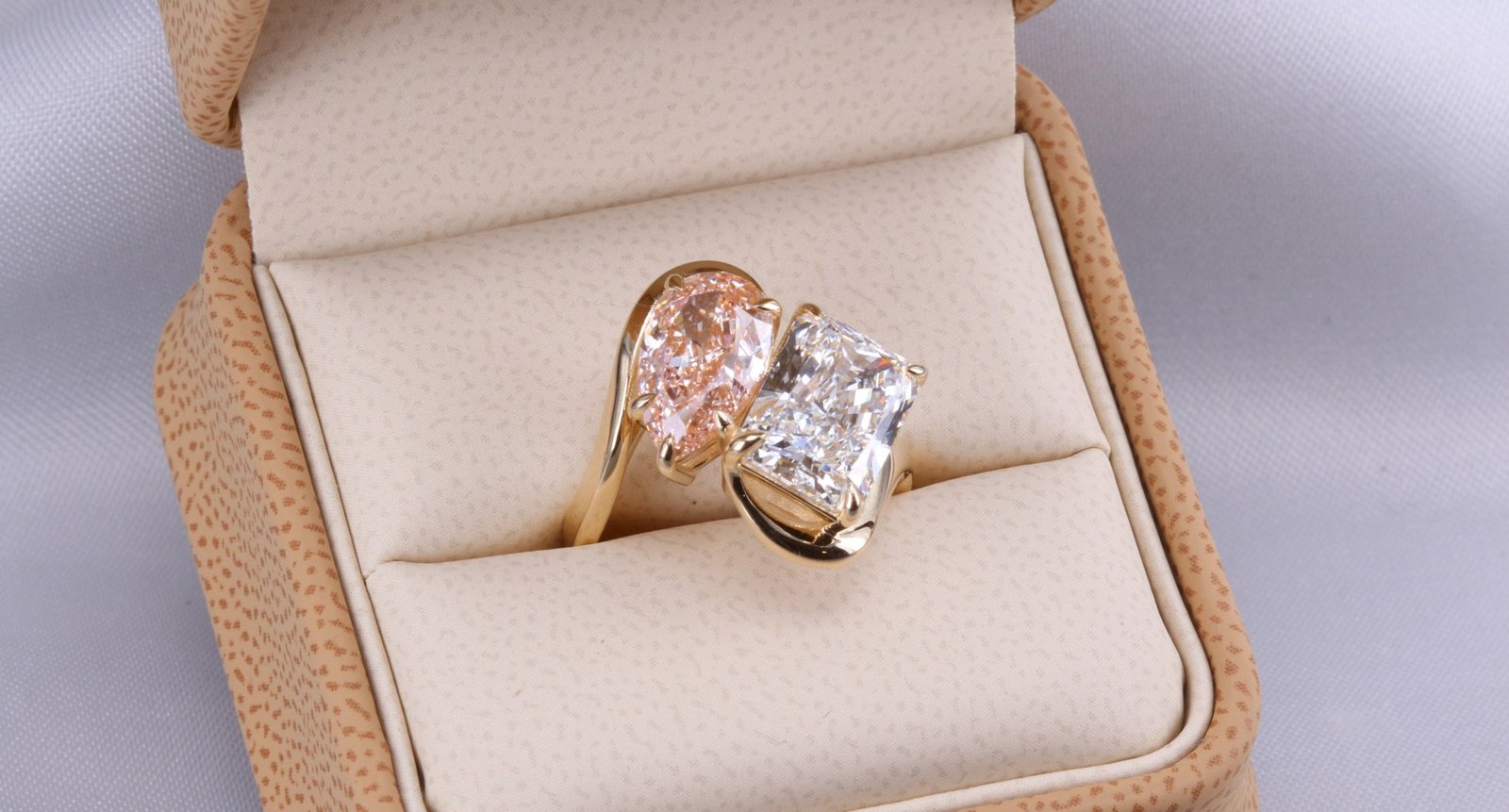
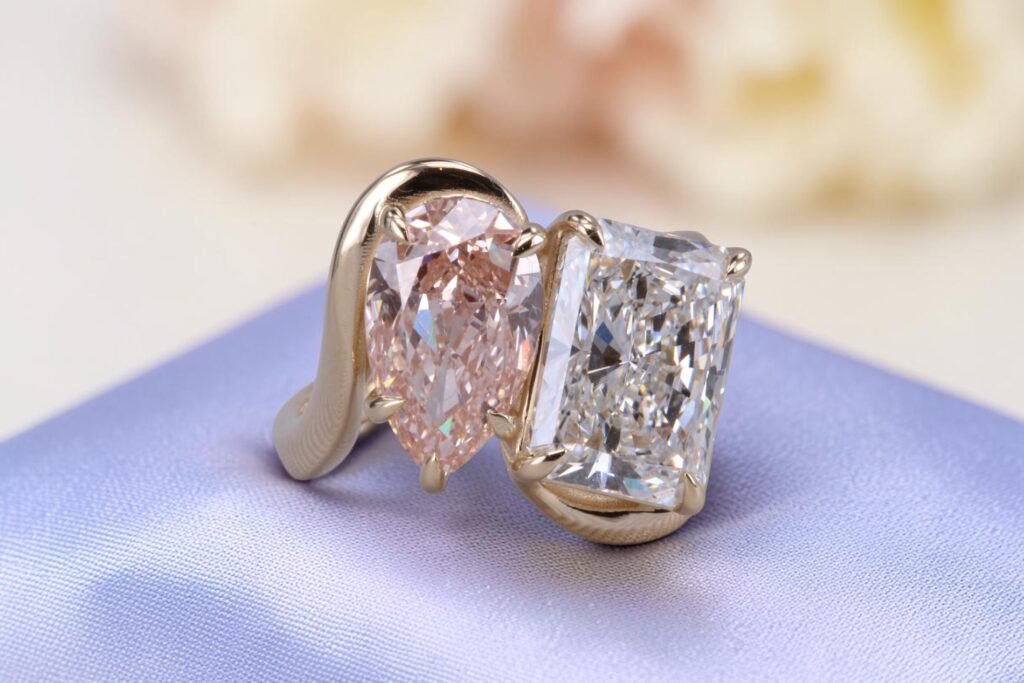
Carl Blackburn’s recent custom engagement ring shows how far that idea can be pushed: a 4.25-carat radiant-cut lab-grown diamond paired with a 3.03-carat pear-shaped pink lab-grown diamond, set in 14k yellow gold — 7.28 carats total, yet the design never reads as two large stones simply placed side by side.
The straight architectural lines of the radiant meet the tapering outline of the pear, and the yellow-gold band sweeps around both in an open, sculptural gesture that draws them into one composition without erasing their differences.
A Love Story More Than Two Centuries Old
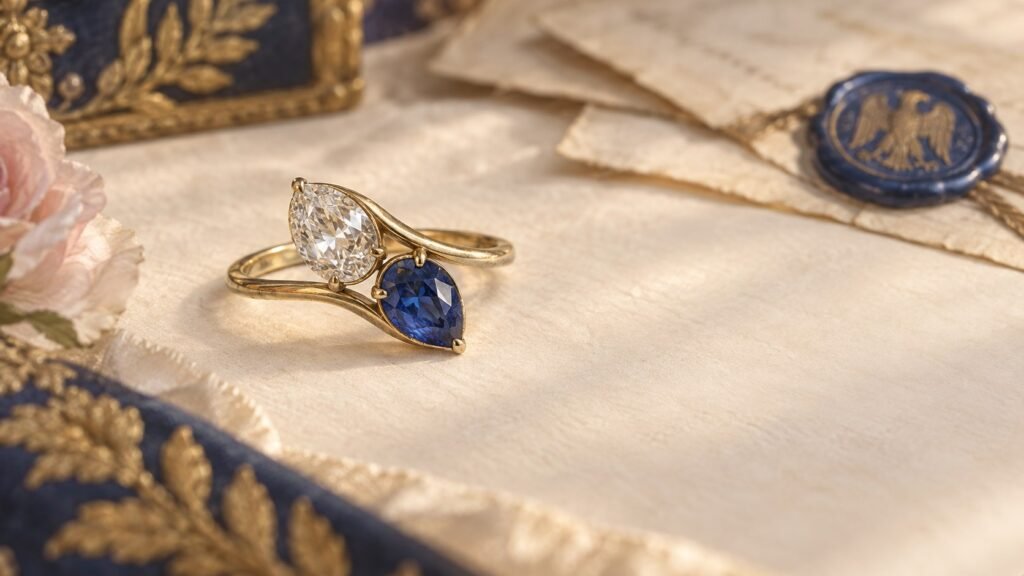
Two-stone rings have taken many forms, but the Toi et Moi is most closely tied to Napoleon Bonaparte and Joséphine de Beauharnais. In 1796, Napoleon gave Joséphine a ring set with a pear-shaped diamond beside a similarly shaped blue sapphire, the two gems pointed in opposite directions on a slender gold band.
The engagement ring was modest in scale, but its resonance wasn’t: when it was auctioned in France in 2013, it sold for €730,000, far beyond its estimate. Its importance was never really about size — it was the clarity of the idea: two people, two gems, one setting.
That two-stone ring didn’t establish a rigid formula so much as provide later jewelers a flexible language. Some Toi et Moi engagement rings use matching diamonds for symmetry; others pair a diamond with a sapphire, ruby, or emerald. Contemporary versions go further still, combining contrasting shapes, orientations, and colors.
The category overlaps with bypass rings, whose bands curve past one another rather than meeting at a centered setting, but the defining feature stays constant: two stones, neither one clearly subordinate.
The style has also had a real resurgence in recent years as San Diego couples look beyond the conventional single center stone and choose rings that pair a diamond with a pearl, colored gem, or contrasting diamond. It’s part of why the design reads as current rather than antique, even though its most famous example is over 200 years old.
Why Two Stones Feel So Personal
A traditional three-stone engagement ring is often read as past, present, and future, with a dominant center stone flanked by two smaller ones. A two-stone ring has a different rhythm — neither gem has to function as an accent. Each can stand for one member of the couple, or two chapters of a shared life, or two qualities that get stronger together.
That symbolism lands hardest when the stones are deliberately unlike each other. A geometric emerald, radiant, or Asscher cut diamond can meet the softer silhouette of a pear, oval, or round brilliant; a colorless diamond can meet a colored one. One stone may be larger, but careful placement keeps the smaller gem from ever reading as secondary — which is precisely the design problem worth digging into.
Designing Balance Without Symmetry
Two diamonds of equal carat weight can look very different in size, since carat measures weight rather than visible surface area. Shape affects perceived mass too — a pear draws the eye along its point, while a radiant presents a broader, rectilinear face — and color adds another layer: a pink diamond can command attention even at a lower carat weight than the colorless stone beside it.
In Carl Blackburn’s Toi Et Moi ring, the radiant cut’s clipped corners and brilliant-style faceting give it structure and strong light return, functioning as the composition’s anchor. The pink pear’s rounded end softens that structure, while its point pulls the eye inward and up through the ring.
The two stones sit close enough to read as a pair without crowding each other — crucial, since crowded prongs and girdles create visual clutter, while stones set too far apart lose the symbolic connection entirely and start to look like two separate rings.
Here, the sculpted yellow gold does the connecting: it rises and curls around the outer edges of both diamonds, echoing the traditional bypass form while giving the whole thing a more fluid profile.
Prong placement carries its own demands. The radiant’s corners and the pear’s pointed tip are both vulnerable points that need protection without blocking the open view of the stone. At this scale, the design also has to manage height and weight distribution for everyday wear — a dramatic top view only works if the engineering underneath holds up.
How Lab-Grown Diamonds Made This Possible
The use of lab-grown diamonds here isn’t incidental — it’s what made this particular scale and color combination attainable at all. Lab-grown diamonds are diamonds, not simulants like cubic zirconia or moissanite: they have essentially the same chemical composition, crystal structure, and optical and physical properties as natural diamonds.
Gemological labs can still tell the two apart, typically using spectroscopy to detect trace patterns left by the growth process, and a grading report will disclose both the growth method and any post-growth treatment.
Pink makes the cost gap especially stark. Large natural pink diamonds are among the rarest gems in the world — their color usually comes from distortion within the crystal lattice, and exceptional natural examples have sold for millions of dollars per carat. A natural pink diamond over three carats, paired with a colorless diamond over four, would put a ring like this out of reach for nearly everyone.
A lab-grown pink diamond changes that math by a wide margin, which is what let the pink stone here be large enough to genuinely counterbalance the radiant rather than serve as a minor accent — the whole point of a Toi et Moi design.
Choosing Two Stones Together
Selecting the diamonds isn’t a matter of finding two attractive stones independently — they have to be evaluated as a pair. What matters most: face-up dimensions, outline, color relationship, facet pattern, and how orientation affects the ring’s overall span. Carat weight is a useful number, but millimeter measurements usually say more about how the stones will actually share space on the finger.
A jewelry designer like Carl Blackburn will often test several pairings to see whether the gems sit at the same height, whether one should rotate, and whether their nearest edges should align or overlap — small angle changes can shift the whole ring from formal to fluid.
Lifestyle matters too. Large, outward-facing stones make a strong statement but need secure settings and periodic prong checks, and the ring should come off for anything involving impact or abrasion. It’s worth settling the wedding-band pairing at the design stage as well, since some Toi et Moi rings sit comfortably with a straight band and others need a curved or custom-fitted one.
The Idea Behind the Two-Stone Ring
What makes Toi et Moi and two-stone engagement rings endure is that its symbolism and its design are inseparable. The two stones aren’t decoration on the ring — they are the ring.
Carl Blackburn’s design carries that forward without copying it: a radiant and a pink pear, in yellow gold, solved with entirely modern tools. More than two centuries after Napoleon gave Joséphine a ring built around the same idea, the underlying bet hasn’t changed — that two distinct things, given equal weight, make a better story together than either one alone.
If you are considering a two-stone ring or another custom engagement ring, contact Carl Blackburn at C. Blackburn Jewelers in La Jolla, CA. He can help you select the right diamonds or gemstones and create a one-of-a-kind design that tells your own story.
📞 Call 858-251-3006 or text 619-723-8589.
Related La Jolla Jewelry Posts:
 Pink Diamonds: An Engagement Ring Buyer’s Guide
 A Guide to Radiant Cut Diamond Engagement Rings in San Diego
 Pear Diamond Rings & Jewelry – All Your Need to Know
 San Diego Lab-Grown Diamonds: What You Need to Know
 How to Buy an Engagement Ring on a Budget in San Diego
 Euro Shank Engagement Rings: Form, Balance & Design